Showing posts with label China. Show all posts

Saturday, March 22, 2008

China Forex Reserves jump to US$1.65 trillion

China’s foreign exchange reserves has reached US$1.65 trillion, up by US$57.3bil in February, almost matching January’s surprising leap of US$61.6bil.

The increase is more than three times greater than February’s combined inflows from the trade surplus and foreign direct investment (FDI).

Economists have offered various explanations for the US$61.6bil jump in reserves in January to US$1.59 trillion. These include speculative inflows, an increase in onshore dollar lending and more active trading in onshore currency forwards.

Whatever the reason, the pace of accumulation in the first two months dwarfs last year’s average monthly increase in China's reserves of US$38.5bil.

The reserves, the world’s largest, have ballooned because the People’s Bank of China (PBOC), in order to hold down the yuan, buys most of the dollars that flow into China.

(source: TheStar: China forex up US$57b in February)

Malaysia's total foreign exchange reserve as at Febuary 2008 is US$116.3 billion (source)

It was US$101 billion in December 2007 (source)

Foreign exchange reserve is accurately deemed as official reserves or international reserves.

Bank Negara Malaysia Forex

Bank Negara Malaysia Forex or BNMF is the Malaysian central bank foreign exchange.

Recent history

In 1985, following the "Plaza meeting" of G-5 finance ministers in New York City, the US dollar fell sharply causing major losses in Bank Negara's dollar reserves. The bank responded by starting a program of aggressive speculative trading to make up these losses. Jaffar Hussein, the Bank Negara Governor at the time, referred to this strategy as "honest-to-God trading" in a December 1988 speech in New Delhi.

In the late 1980s, Bank Negara under Governor Jaffar Hussein, was a major player in the forex market. Its activities caught the attention of many; initially, Asian markets came to realize the influence Bank Negara had on the direction of forex market. Alan Greenspan acting the Federal Reserve chairman later realized Bank Negara's massive speculation activities and requested the Malaysian central bank to stop it.

BNM sold between $500 million on September 21, 1990 - $1 billion worth of pound sterlings in a short period, driving the pound down 4 cents on the dollar. In response, bankers began front running Bank Negara's orders.

Two years later, Bank Negara attempted to defend the value of the British pound against attempts by George Soros and others to devalue the pound sterling. George Soros won and Bank Negara reportedly suffered losses of more than USD $4 billion.

Bank Negara lost an additional $2.2 billion in speculative trading a year later .

By 1994, the bank became technically insolvent and was bailed out by the Malaysian Finance Ministry.

Tuesday, July 24, 2007

Microsoft Conquer China or was Conquered

How Microsoft Conquered China

Or is it the other way around?

by David Kirkpatrick
Fortune 500
July 23, 2007
Vol 156, No.2

Abstract:

No other Fortune 500 CEO gets quite the same treatment in China. While most would count themselves lucky to talk with one China's top leaders, Bill Gates gets to meet with 4-members of the Politburo.

When Chinese Premier Hu Jintao visited Microsoft campus in Redmond, Washington, and was feted at a dinner at Gates home, Hu told his host: "You are a friend to the Chinese people and I am a friend of Microsoft. Every morning I go to my office and use your software."

Microsoft bumbled for years after entering China in 1992. It finally figured out that almost none of the basic precepts that led to its success in the US and Europe made sense in China.

It took Microsoft 15 years and billions of dollars of lost revenue to learn how to do business in China. "We were a naive American company," concedes Gates in an interview.

15 years ago, Microsoft sent a couple of sales managers into China. Their mission? To sell software. "It was a classic model - hang out a shingle and say, 'Microsoft: Open for business," Craig Mundie, the top Microsoft executive who now guides its China strategy said.

But the model failed, not because of brand acceptance but just that no one is paying - counterfeiting.

"In China we didn't have problem with market share. The issue is how do we translate that into revenue," said Ya-Qin Zhang.

Microsoft fought bitterly to protect its intellectual property. It sued but lost regularly in Court. Microsoft's strategy failed miserably and in a 5 years period, they had changed 5 country manager.

In 1999, Gates sent Mundie to figure out why Microsoft was so reviled. On the trip he had an epiphany: "Our business is just broken in China."

Mundie concluded that the company was assigning executives too junior and that selling per se was overemphasized. "Our business practices and our engagement did not reflect the importance of having a collaborative approach with the government."

Microsoft executives were concerned with China's weak IP-enforcement laws. However, Gates argued that while it was terrible that people in China pirated so much softwares, if they were going to pirate anybody's software Gates certainly preferred it to be Microsoft. Bill Gates openly concedes that tolerating piracy turned out to be Microsoft's best long-term strategy. That's why Windows is used on an estimated 90% of China's 120 million PCs.

"It is easier for our software to compete with Linux when there's piracy than when there's not," Gates says.

Microsoft's China strategy is clearly paying off. More than 24 million PCs will be sold this year, adding to the 120 million already in place.

"We have already found a win-win way of doing things together that will generate a substantial part of Microsoft's growth in the next decade," declared Gates.

(go get a copy of the Fortune 500 Vol. 156. It's worth it, just for this piece.)

Tuesday, July 17, 2007

UEM sold 51% to China? NEP Betrayed?

UEM said they had agreed in principle to sell 51% stake to China Harbour Engineering Co (CHEC) in the JV Consortium for the construction of the 2nd Penang Bridge.

Wouldn't this go against the fundamentals of the government policy and regulations as per DB/T contract (Design-Built-Turnkey) and defeat the sacred interest as presupposed in the New Economic Policy? Why is UMNO Youth quiet about it? Aren't they not worried and concerned that the Bumi-Malay equity will be diminished and that the 30% equity target marginalized?

I am not against CHEC. I like to remind that whatever sold to CHEC is against the tenet, as none - no Malaysian had stand to benefit from the 51% stake; it only benefited China Harbour, not Malaysian Chinese. Don't ever take that stake into consideration when tabulating the distribution and the 30% saga.

In Star Metro, page 2, Selangor MB Khir Toyo reminded Malaysian that UMNO will continue to struggle and keep the NEP to ensure the interests of the Malays [??? few] are protected. Khir said the NEP had not marginalised "other" races (It may have marginalised it's own; check urself). I am not sure he knows what he is talking about and how statistics and mathematics are tabulated. There is no need to discuss about this as it is a priori and a fortiori.

Monday, September 05, 2005

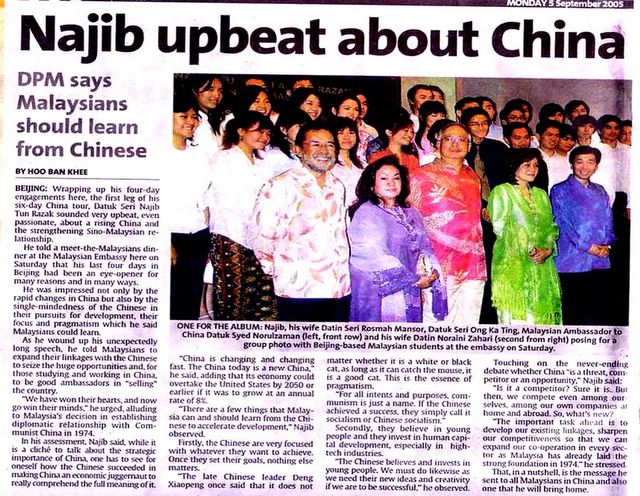
What Najib had learnt about China


Wrapping up his four-day visit of China, Datuk Seri Najib Tun Razak was certainly upbeat and passionate about the rising China and the strengthening of Sino-Malaysian relationships. According to Najib, it was an eye-opener for many reasons and many ways.

Najib was impressed by the rapid changes and the single-mindedness of the Chinese in their pursuits for development, their focus and pragmatism which he believes Malaysians could learn.

In his assessment, Najib said "one has to see for oneself how the Chinese succeeded in making China an economic juggernaut to really comprehend the full meaning of it".

“China is changing and changing fast. The China today is a new China. China’s economy could overtake the United States by 2050 or earlier if it was to grow at the rate of 8%,” Najib said.

According to Najib, Malaysia can and should learn from the Chinese to accelerate development.

Firstly, the Chinese are very focused with whatever they want to achieve. Once they set their goals, nothing else matters. Najib enunciated the late Chinese leader Deng Xiao Peng famous philosophy:

“It does not matter whether it is a white or black cat; as long as it can catch the mouse, it is a good cat.”

To Najib, this is the essence of pragmatism.

Secondly, China believes in young people and they invest in human capital development, especially high-tech industries.

Najib believes that Malaysia must do likewise as we need their new ideas and creativity if we are to be successful.

The Star concluded that in a nutshell, this is the message Najib wants to sent to all Malaysians.

Najibs foresight is beyond apprehension. But, would what he preach, could it be possible to get them implemented in Malaysia? Let's look at various challenges:

1) The essence of pragmatism

In Najib's opinion and his illustration of pragmatism, "as long as the cat can catch the mouse, it is a good cat." What will that mean in the Malaysian context? Take the case of Malaysian Airline System (MAS) as a case study. To apply this philosophy, it means that MAS must select the best person to helm the institution, and it does not matter what is the color of his skin and his nationality. In juxtaposed, UMNO Youth Leader and Education Minister UMNO Datuk Hishamuddin said the proposed appointment of a foreigner to lead the nationally-owned carrier by Khazanah could be likened to allowing the country to be recolonised, albeit in a new manner. “Don’t look at it from the commercial aspect but (we) should look at the bigger agenda, that is the Malay Agenda,” Hishamuddin said.

Do we see a total different ideology? Both of which is enunciated by UMNO - one from the deputy UMNO President and the other from UMNO Youth President. Isn't it a clash of ideology and a Conundrum? What it goes to show without doubt is that UMNO knows what is good for Malaysians and what is needed to achieve national development, but it is unable to apply the knowledge because of it's need to sustain the political support from the masses to keep it in power. Any acts that could cause a radical change and a possible removal of clutches from the political Bumi-acolytes who are beneficiaries of the rent-seeking system will cause certain disruptions and resistences within UMNO.

2) Malaysian Human Capital Development vs Malay Human Capital Development

In Najib's second point, he highlighted that China are currently investing in human capital development, especially high-tech industries. Najib believes that Malaysia must do likewise as we need their new ideas and creativity if we are to be successful.

Again, we have to look at the juxta-position of UMNO. The Johor Umno Liaison Committee under the leadership of Johor's Chief Minister Datuk Abdul Ghani Othman had criticised the meritocracy system introduced by the Malaysian government, blaming that it resulted in a fall in the achievement of Malay students and that the semi-meritocratic system of admission of students is a form of discrimination and oppression as it had resulted in a fall in the number of Malay students in medicine, engineering, pharmacy, dentistry and other competitive fields. He said the system had prevented the entry of Bumiputera and non-Bumiputera students into public institutions of higher learning based on the 55:45 ratio as used in the quota system.

Do you believe it? Meritocratic system is discriminatory and oppressive? What type of oxymoron do we have in Malaysia, especially so when that statement is made by a Chief Minister who is a university graduate and was a lecturer himself before he shot to political supremacy, and who is married to a professor who is a dean in the Public University.

On the 23rd Sept 2004, The Star highlighted that WANITA UMNO has identified a new “Malay dilemma” that will affect the younger generation should they continue to ignore the importance of knowledge. Its chief Datuk Seri Rafidah Aziz said “knowledge poverty” would definitely be the new Malay dilemma if the younger generation lagged behind in their studies and failed to give priority to acquiring knowledge. She said poverty in knowledge would eventually marginalise young Malays from the mainstream of development, hence reducing their ability to be creative and innovative.

Again, on 27th Sept 2004, in The Star news article: Advancing the Malay Agenda - Change of mindset vital for success; Education Minister, Hishamuddin had this to say:

“Unless there is a guarantee of a level playing field, Malays will never be able to compete fairly.” What sort of level playing fields is Hishamuddin refering to? The acceptance of admission of Malay students to Public universities and the scholarships awards were already one-sided and lop-sided in the Malays' favor; how is it that Hishamuddin and his deputy in UMNO Youth, Khairy Jamaluddin could still claim that the Malays are not playing in a level field? Paradoxically, it should be the reverse. If the rural schools which do not have appropriate amenities and facilities were the reasons of the rural Malays weakness in their education, then it is no fault of the commoners, especially the non-Malays. It should be the fault of the State Government of which Ghani is the chief minister, and he should take the full responsibility for the failures.

Meanwhile, at the UMNO General Assembly in July 2005, UMNO Youth deputy chief and the Prime Minister's only son-in-law, Khairy Jamaluddin was cheered by the delegates as he called for a return of the New Economic Policy (NEP) and this loud and open call was no longer a hidden agenda or something only in spirit and soul.

In Khairy assertion, he said this should be the basis for the country's economic planning in the coming Ninth Malaysia Plan with no shame or excuses. “No need to hide. This is the Malay agenda. We want 30% equity for the bumiputras so that they will be on par with the other races.”

How does Khairy propose to get the 30%? Burgle? Steal it? Rob Paul and Peter and Ah Chong? Or, earned it by hard work? If what Khairy is enunciating is about hardwork, then the need for NEP becomes irrelevant. The NEP is fundamentally a rent-seeking system, a system to give away national wealth without the need to work for it; a system that legalized theft, robbery and burglary of others' property and wealth ownership, in the name of economic wealth distribution for the oligarchs, and the assertion that Malays do not have a level playing field was used as the basis to cry for more hand-outs and the extensive exercise of cronyism and nepotism ideology.

Is that what Khairy wants? Then, Najib's philosophy of hardwork, competencies, and single-mindedness in pursuit for economic development, focus and pragmatism which he believes Malaysians could learn, is obsolete and redundant. Ironically, this was the same philosophy enunciated by Khairy's father-in-law, the current Prime Minister of Malaysia but seemingly, a follower to his S-I-L.

It goes back to the fundamental basics - Cakap Tak Boleh Serupa Bikin! which literally means, "Do what I tell you to do; Not what I do!

In summation, the hypothesis is affirmative of the doctrine of Malaysia-Boleh!

Tuesday, December 14, 2004

Nike's commercial an insult to Chinese Dignity


Nike Uproar Posted by Hello

CHINA BANS NIKE'S COMMERCIAL

NIKE apologized for their “Blasphemous” television commercial codenamed “Chamber of Fear”, which was banned by China after a wave of protest, saying it was only intended to inspire courage among youngsters.

NIKE regrets the “Chamber of Fear” television advertisement which had offended the people of China and had shown disrespect to the Chinese culture.

The commercial showed LeBrom James defeating a kung fu master, two women in traditional Chinese attire and a pair of dragons, considered a sacred symbol in Chinese culture.

It is not the first time NIKE has run into trouble with its advertising campaigns. In August, it was forced to withdraw from Australia television an advert featuring young girls trying to impress a male tennis coach after morals groups complained it trivialized paedophilia.

The commercial costs Nike millions of dollars to produce and most likely, it would also caused their sales to suffer hundreds of millions if actions are taken to boycott their products in China.

The Americans thinks their basketballers can defeat anybody, and anything in the world, including the great dragons. It just goes to show how arrogant they are.
It also goes to show how American advertising companies bring "VALUES" to their customers...... "The American Way in line with the BUSH DOCTRINE......