Showing posts with label Poverty. Show all posts

Sunday, August 21, 2011

A trip to Dhaka

If we think the traffic jam is horrific in Kuala Lumpur, then you have to visit Dhaka to appreciate KL. It took us nearly 5 hours to get to a destination which is only 5km away from the Pan Pacific Hotel in Dhaka.


See the traffic ahead of our car.

If the traffic is bad enough, you have to experience the driving skills of the Bangladeshi.
Michael Schumacher would be terrified by the driving manners.

It was an honour to meet up with our Malaysian Ambassador to Bangladesh,
H.E. Jamaluddin Sabeh


and we met up with the Minister of Housing & Public Works (PWD),
Advocate Abdul Mannan Khan


Journeying along the streets of Dhaka, we will learn to appreciate our own streets:


Along the journey we also learn what it means to be poor.

What is a home? See below:


I will be making another trip to Dhaka next month.

***

Sunday, September 05, 2010

EPD: The Case of Citra

Fifteen year old Citra Dorai was born in a prison in Alor Setar and her knowledge about the circumstances surrounding her birth is rather vague.

She has been illiterate all her life as she does not have a birth certificate or an identity card which makes it impossible for her to register for any school.

Her mother died recently and her father has left her and two other siblings in the care of an aunt, and Citra is totally uncertain of her future.

"I want to be like everyone else, to go to school, and to have something to do in the future," she said, teary-eyed.

Citra, is a stateless person.

Citra is also part of the 150,000 Malaysians who were born and bred in the country but who continues to suffer as stateless persons for various reasons ranging from not having parents' with citizenship to refusal to follow suit when a spouse or parent converts to Islam.

SOURCE: Malaysiakini: Stateless in Malaysia

***

Friday, September 03, 2010

EPD: Economic Policy Discard


These four children have never eaten a grain of rice in their life.

Biscuits was their only food to starve off hunger.

Their father was jobless for months. Previously he worked at a workshop which closed down.

He has to borrow money from Ah Long to survive. Now he has to hide from them.

The children's mother ran away.

The children aged 4, 8, 9 and 10 had never been to school. Their father taught them Bahasa Malaysia and Mandarin at home.

Our economic policies could not take them into consideration as they are Chinese. The Chinese were classified as rich.

***

Sunday, April 12, 2009

One Malaysia belongs to Awang Selamat

Figuring out OneMalaysia
by The Malaysian Insider


What is One Malaysia? This has been troubling supporters of Umno since Datuk Seri Najib Tun Abdul Razak announced it in his maiden speech as prime minister nine days ago.

Today, the Umno-owned Mingguan Malaysia refuted that connotation in an opinion piece and put in perspective that One Malaysia means affirmative action policies will continue.

In his opinion piece headlined ‘Satu Malaysia versi sebenar’ Awang Selamat allayed fears that Najib will end the NEP and ensure equality for all.

“Awang hopes the true version of One Malaysia is understood clearly. The affirmative policies to help the Malays who are left behind (compared to other races) will continue.

*******************************************
Source: The Malaysian Insider

********************************************
I think OneMalaysia means people like Awang Selamat and his families will continue to enjoy the privilege over and above everyone else. Just make them rich without effort and Awang and his cohort will be selamat. Otherwise, we will be in shit.

Saturday, January 24, 2009

Slumdog Millionaires

The real Slumdog Millionaires: Behind the cinema fantasy, mafia gangs are deliberately crippling children for profit

Alone and afraid, Aamir was initially grateful when a 'kind' older couple befriended him on his arrival in Mumbai. This chaotic urban sprawl is now India's largest city and home to more than 20 million people. More than nine million of them live in slums, raising families in shacks built from rubbish on top of open sewers. For a homeless 12-year-old child freshly arrived from the countryside, it is a terrifying place to be.

Overcrowding is now so bad in this huge metropolis that shanty towns have even sprung up in the international airport. People in rags scavenge as giant jets thunder past just feet away.

But for many on the Indian sub-continent, Mumbai will always be the city of dreams — a place of Bollywood film stars and gold-paved streets. It was certainly the image that brought Aamir here.

Fleeing a violent, drunken father in rural India — his mother had died years before — the12-year-old had sneaked on to a train bound for the city. And when he got there, he hoped to make his fortune.

It was not to be. Alighting at Victoria Station, the city's main terminal and an architectural monument to the days of the British Raj, Aamir was penniless and bewildered. He started begging for food.

Within minutes, a couple emerged from the crowd and approached him. They gave him cakes and said they'd take him away to start a better life.

'I thought they were maybe social workers or religious people,' he told me.
But Aamir's food was drugged and when he became drowsy, the couple put him in a rickshaw and took him to the city's municipal hospital, which is where the real nightmare began.

For at the hospital, a doctor was paid to amputate one of his healthy legs. Now speaking in the third person, as if to pretend it didn't happen to him, Aamir tells me 'the child' was in 'great pain' after the operation.

'The leg is removed here,' he says, pointing to his own stump and grimacing. His limb had been severed mid-calf, leaving him without a foot.

Now in hiding after being rescued from the hospital by a charity, Aamir is one of hundreds of Indian children deliberately crippled by gangs so they can earn extra money begging. He still struggles to talk about his experience.

Asked to describe what he thinks about those who ruined his life, he just stares at the ground in silence. Crippled for life, he is now the lowest of the low.

Dalbeer, 15, is another victim of this shocking industry. Reduced to begging at the railway station after his parents died, Dalbeer was approached by two friendly older strangers one day. 'I thought they were maybe social workers,' he told me. 'I thought they could help me.'

But he was taken from everything he knew to Nagpur, a city a thousand miles from Mumbai, after the woman told him it would 'be better there'.

And there, along with several others, he was deliberately crippled before being brought back to Mumbai and put to work begging. His leg had been severed in the same place as Aamir's.

So just who would chop off the leg of a healthy child? The boys are victims of India's so-called 'beggar mafia' — criminals so violent and amoral that they are prepared to hack the limbs off children, as well as steal new-born babies from hospitals.

They use the children as begging 'props' to maximise their earnings from sympathetic passers-by. The plight of India's child beggars has been thrust into the international spotlight by Slumdog Millionaire, the British-made film tipped for Oscar glory with a staggering ten nominations. It has already won an unprecedented four Hollywood Golden Globes.

Directed by Danny Boyle, Slumdog Millionaire tells the story of Jamal, a boy who escapes the slums of Mumbai and wins a fortune on the Indian equivalent of the TV game show Who Wants To Be A Millionaire?

Branded 'poverty porn' by some Indian critics, the film has caused controversy in a country that wants to promote itself as a modern economic super-power.

Due to open in India this week with the Hindi title Slumdog Crorepati, the film-makers have been criticised by police and politicians for painting an 'outdated' portrait of a corrupt, violent country.

Their anger centres on a scene in which an Indian boy is intentionally blinded by gangsters so that he can earn more as a beggar.

'They are making out that India is a Third World, dirty underbelly, developing nation,' snorts Amitabh Bachchan, one of the country's leading film stars and a powerful, patriotic voice.

Now home to thousands of 'outsourced' British jobs, such as call centres, many insist that such brutality has been banished from the 'new' India.

Yet the truth, as I discovered during a chilling week-long investigation, is more disturbing than anything dreamt up by the creators of Slumdog Millionaire.

For in Mumbai, as well as in other major Indian cities, hundreds of young children have had their arms and legs chopped off; scores of others have been blinded. The gangs also pour acid on to the children's bodies, leaving them with suppurating wounds.

Their suffering comes down to one thing: money. In a country of 1.2 billion people, where the gulf between rich and poor is vast, there are an estimated 300,000 child beggars.

By no means all are mutilated by the beggar mafia, but those with the worst injuries do make the most money — up to £10 a day for deformed children, a fortune in a country where millions survive on just a tenth of that.

Not that Aamir and Dalbeer saw any of their earnings. After being crippled and put to work on the streets, the children are forced to hand over the cash to gang masters each evening. And if they don't hit their 'targets', they are beaten and tortured.

Perhaps unsurprisingly, almost all of these child beggars, whether mutilated or not, are addicted to solvents, alcohol and charras (powerful Afghan hashish, often laced with opium), which are supplied by the gang masters to keep the children under control.

'It helps us forget where we are,' says Tufhaar, nine, a child beggar who had his left arm removed and constantly sucks on a bag filled with glue. Right across this chaotic city, amputees line the streets, operating in aggressive gangs at every intersection and tourist attraction. Many maimed children are terrified of speaking out, saying their limbs 'just disappeared' or blaming unspecified 'accidents'.

This code of silence is understandable. 'The gang masters hold you down and cut out your tongue if they think you have informed,' says Flintoff, 18, a 'reformed' local Indian gangster and former child beggar who wears a T-shirt with a picture of the rapper Eminem.

'I still steal now and again, and sell drugs — but I keep away from the beggar mafia. These men are not human.'

Mohini Nerurkar, 33, agrees with Flintoff's assessment. After giving birth to a boy last week, she was recovering at the city's Sion municipal hospital when a woman posing as a social worker in a neat yellow sari asked if she could examine the baby.

Glad of a break, Mohini went to wash her four-day-old son's nappy. But when she returned, her baby had been taken. The 'social worker' is believed to have been part of a gang which steals babies for the beggar mafia.

With at least one child being taken every week in Mumbai, not to mention dozens more in India's other overcrowded cities, Mohini received no sympathy from the authorities. 'The mother shouldn't have spoken to a stranger,' says hospital physician Dr Sandhya Kamat, ruling out any hope of the baby being recovered.

Inspector Sanjit Kavdakar, the detective in charge of Mohini's case, says begging has become big business for the crime syndicates. 'There is a lot of money involved in it and it is highly organised. Mafia people are stealing these children simply to use in begging.'

Two other children were abducted by the mafia in a single day last week: Asiya, aged three, disappeared from outside her home in a slum to the east of the city, while Faiz Sheikh, 13, was taken from another slum to the west. Both girls' parents blamed 'beggar mafia goons' for stealing their children.

Complaints to the police are pointless. With the beggar mafia making more than £20 million a year in Mumbai alone, corrupt officers ensure that the trade thrives. According to official figures, as many as 44,000 children fall into the clutches of the beggar mafia in India each year and of these, hundreds are deliberately mutilated.

However, some charities say that the figure could be as high as a million. Most of the victims are under ten. 'They are taught the most appropriate place to beg, the kind of people one should approach, and the kind of mannerisms that would make people sympathise,' says Mufti Imran, a researcher with Save the Children.

The more a person is tortured or tormented, the more unfortunate he looks — all this will evoke more sympathy among the people who will then give them alms or gifts,' he adds.

The shocking truth about the beggar mafia emerged last year. In what was dubbed the 'arms for alms' scandal, doctors were filmed by Indian journalists agreeing to cut off the healthy limbs of children for just £100.

The maiming of children is now so widespread that even devoutly religious locals refuse to give disabled children money, knowing that it is passed straight to their 'handlers' and that they are the pawns of a growing organised crime syndicate.

'I don't give them a penny,' says Father Barnabe D'Souza, a Catholic priest, who has worked with homeless children for 25 years and now runs a refuge to which they can escape and be weaned off drugs.

'If they approach me on the street, I offer them food, which they don't want,' he says. 'There is no room for emotion. This is a business — a mafia. These children are taught how to look as pitiful as possible to get money — and what they earn just gets taken from them.'

Many of Mumbai's child beggars live in Dharavi, Asia's biggest slum. Here, a million people live in a labyrinth of tunnels and walkways where sewage flows openly through the streets and violence is rife.

During my visit to this slum, a group of child beggars stinking of alcohol and solvents press round me, asking for money and pulling at my pockets. Vicky, at 17 one of the oldest, says he no longer has his money taken from him by the beggar mafia.

'I've started taking the money off the younger children,' he laughs. Jahan is a 'street level' gang master, who, in turn, pays off other gangsters higher up the criminal pecking order.

On pain of a savage beating or worse, his children hand over their spoils to him each night. Working 'his' beggars in shifts, he makes around £50 a day — a fortune in a country where the average monthly wage is less than £100.

As well as soliciting money from tourists, these children are the lifeblood of the criminal underworld. They are also used to sell bootleg DVDS and drugs, and to beat up anyone who tries to encroach on their gang master's patch.

'The terrorist attacks mean that there are fewer tourists,' Jahan tells me. 'So we are selling everything we can until they come back. We have Afghani opium, Kashmiri black, King Charles (cocaine) and pure brown from Pakistan (heroin). I will give you a good price.'

'We give the police some money — a little something to let them wet their beaks,' said Jahan, smirking and flashing stained, rotting teeth.

Swami Agnivesh, a child-rights activist, says: 'The beggar mafia is a huge industry and the perpetrators get away scot-free every time. There is collusion between the lawmakers and lawbreakers.'

Not all the 'disappeared' children are maimed or turned into beggars. But all face a truly grim future. According to human rights groups, some are forced into child pornography and used as sex slaves. Others are killed and have their organs sold to wealthy Indians.

On the approach road to the airport, wealthy businessmen hoping to tap into India's huge reserves of cheap labour and cash in on the economic miracle drive past hundreds of child beggars, many of whom have been stolen from their parents and mutilated by cruel gangs.

It is here the two faces of 'modern' India can be seen side by side.

And, despite India's economic boom, the future looks bleak for millions of the nation's children.

'They never really get old,' says Father Barnabe. 'They just get replaced with new ones — and cast out on to the street to become beggars or die. That's the way life is here — it never changes.'

Source: Reuters (sent to my email by BayiSingh)

Wednesday, July 02, 2008

Sabah Poverty Statistics - Plug from the sky?


In Sabah, said Prime Minister Abdullah, the incidence of poverty had declined from 23% in 2004 to 16% in 2007. In Sarawak, meanwhile, poverty had declined from 7.5% to 4.2%.

Abdul Ghapur Salleh (BN-Kalabakan) asked the Prime Minister at the Parliamentary debate: "where did he get his statistics on the incidence of poverty in Sabah and Sarawak?"

Asking this question today, Abdul Ghapur Salleh said his figures on the matter derived from Sabah's Economic Planning Unit (EPU) differed from those cited by the prime minister.

Abdul Ghapur said the government should not seek to band about questionable figures to serve its 'pride' in its efforts to eradicate poverty.

"I do not know where the statistics were gotten from regarding Sabah," said Abdul Ghapur.

"I do not know where this 16% percent came from."

"Let's not utter and take pride in statistics that indicate poverty in Sabah and poverty in Sarawak have declined when we do not know the right statistics. We do not have the right statistics," he asserted.

Abdul Ghapur was also peeved with the announcements of billions of ringgit in development funds that have been allocated to Sabah and Sarawak when these two states still languish in poverty and backwardness.

"We do not want to be given billions (of ringgit) but see no positive action being taken ... We do not want the minister saying we have been given billions while not knowing where the billions of ringgit have gone," he said.

Describing the New Economic Policy (NEP) as having "failed" to improve the general lot of bumiputeras and having achieved "16 to 18 percent" of its planned targets, Abdul Ghapur said a new policy should be formulated with short-term aims that was more in sync with present circumstances instead of one that would take place for 30 or 40 years.

"The ones who formulated the NEP are not even here any longer. Formulate a policy for 5-10 years, only then can we see whether it fails or succeeds," said Abdul Ghapur.

The calling for bumiputera and Malay rights to be upheld need not mean that the rights of non-bumiputeras should be denied, Abdul Ghapur stressed.

Source: BN MP queries PM on Sabah poverty statistics

Thursday, May 08, 2008

Datuk Anifah stunned BN MPs in Dewan Rakyat

"What good is a leader if the people are no longer with him?"

This question was posed by Datuk Anifah Aman to the BN parliamentarians at the Dewan Rakyat yesterday.

This is what he had to say:

"What is the point of persisting with leaders who have deviated from the right path? Do we stick with them?"

Anifah then pondered about the price of blind loyalty to leaders and the price people would have to pay for this.

"What is the use of being loyal to leaders and, in the process, sacrificing our people's future?"

Anifah said: "Independence would be meaningless if the people could not enjoy clean running water or if children had to walk miles to get an education."

Minister Zahid Hamidi asked Anifah if Sabah backbenchers were tempted to cross over to the opposition. Anifah's reply stumped him and a whole lot of BN MPs as well as the oppositions.

"I am not saying I am crossing over. This matter of crossing over is not a serious matter. What is serious is the millions in 5-States in Malaysia who crossed over to the opposition," Anifah said.

This led Datuk Puad Zarkashi (BN-Batu Pahat) to ask Anifah if he would support an anti-hopping law.

Anifah replied that he was against any law that would stop members from exercising their individual rights. "That would be like a police state. What is the point of persisting with leaders who have deviated from the right path?'

Anifah said the most important thing that the government should work on now was to prevent Sabah from going the way of the 5-States ruled by Pakatan Rakyat.

"The important thing now is for Sabah people not to jump like the Peninsula Malaysians did in the 5-States."

Source: Anifah: No harm in crossing over

One important aspect that Datuk Anifah Aman exhorted is the main point of parliamentarians and the ruling regime including the opposition camp is the fact about the interest of the rakyat.

In the words of Anifah, the question of MPs crossing over to either camp is not the main issue but that the millions of voters who had crossed over to Pakatan Rakyat should be the main issue which the Barisan Nasional leaders should have pondered seriously and conduct post-mortem using an internal critical reflective attitude to deduce the fundamental reasons of their defeat and to analyze and reconstruct themselves to a position of strength and to win back the support of the people.

Instead they are spending most of their time in trying to run down the Pakatan Rakyat government and the balance of their time in trying to stopped any cross-overs of their MPs to the other camp.

This is also the same problem with the Pakatan Rakyat government who spends most of their time looking back to past records and trying to construct a devil out from the past regime; and also trying to see how to get the monies from the charitable organization previously managed by the Barisan Nasional wives' organization.

Why the monies from Balkis, Bunga Tanjung, Baiduri or Bindara were distributed to Bakti wasn't the real issue as Bakti is a renown charitable organization with proven track records. The issue can only be if the monies had gone to the pockets of the individual members or office bearers which tantamount to a criminal breach of trust. As it was, the monies from the wives' organization were given to Bakti and PR should not question the validity even if there is legal points of dispute as the action was and is noble and charitable in itself.

If the PR government representatives are sincere to do charity they should contribute monies from their own efforts and garner the public support by setting up more charitable organizations and ensure that monies donated by the people and any organizations towards the charitable institutions would be properly managed for the absolute interest of the poor and needy. There should not be any ideological and political differences between any charitable organizations as all of them are working for the common good of the people - it is about charity, not politics.

Sunday, February 17, 2008

Indian curse Hindraf

COMMENT: Led astray by Hindraf leaders
By : Marc Lourdes

Abstracts/Quotes:

Alcoholism and domestic violence are probably highest among the Indians. As much as they may want to blame the government for their plight, the community cannot absolve itself of blame. We may all not have done enough but still, no Malaysian, whatever ethnicity, can say that the last 50 years have been one of systematic abuse, ethnic cleansing, prejudice and oppression.

Indians form 7% of the population but the number of Indian lawyers and doctors make up almost 20% of the total in the country. However, that doesn't detract from the fact that many Indian youth, deprived of job and educational opportunities because of poverty or other reasons, are either unemployable, unemployed or have resorted to crime.

But to manipulate a people and convince them that they have been deliberately disenfranchised and marginalized is probably the most abhorrent thing any right-thinking person can do in multiracial, multi-religious Malaysia. And it is even more abhorrent and abominable if those manipulating the masses are those who have, despite the persecution they claim, received the opportunities that allowed them to become lawyers.

The provocateurs of the Hindu Rights Action Force (Hindraf) would certainly not win any prizes for standing up for the community. If they have done anything at all, it is to manipulate their community, disgrace their country, and tell such vile lies that even the most cynical of Malaysians would never believe.

They claimed they were going to hand over roses to the prime minister but they disobeyed the law and marched. They said they would bring children and women to the rally. What really happened? There were no roses, hardly any children. And the organiser, P. Waytha Moorthy, was in London while the supporters faced off with the police.

Waytha Moorthy, his brother Uthayakumar and the four other Hindraf leaders now detained under the Internal Security Act, did the same during the November rally.

They hid in air-conditioned comfort while thousands marched the streets defying police and taking the brunt of the water cannons and tear gas. They only came out when the protest was almost at its end and tried to claim glory.

Heroes? What kind of heroes are they? Instead of uniting the Indians, they further divide them...

Have they helped the Indians at all? Even the media in India, to which these Hindraf leaders went running to seek sympathy against their own country, said these leaders had done more damage to the Malaysian Indian cause than help.


The fact is that there are 10 members of parliament from the Indian community -- nine from the Malaysian Indian Congress and one from the People's Progressive Party. But in none of those parliamentary constituencies do Indian voters represent more than a quarter of the electorate.

In fact, in seven of these constituencies, the Indian electorate accounts for only between 11 and 19 per cent of the voters. In six constituencies, Malays form the majority and in four, the Chinese are slightly higher than the Malays.

So, if Indian votes were the criterion to win, would any Indian be able to be a member of parliament?

But what does Hindraf really want the Indians to do? Vote against all these Indian MPs from the government party, they said, purportedly to enhance the "Indian cause" as espoused in their rally yesterday.

What if the Chinese decided to place a Chinese candidate in the four Chinese majority seats and Malays in the other six?

Which Hindraf supporter would represent the Indians in parliament or government? Stupid. (unquote)

Those interested to read the article, this is the link.

So, the Indians and the Hindarfs are called "Stupid" by Marc Lourdes. Uthayakumar and 4 others are in detention camp. They could have hide in their air conditioned office and enjoy themselves, earning reasonably well as lawyers, and needn't bother about all the other Indians who remained poor and destitute. They could have just left all those Indians' plight to MIC and Samy Vellu to handle, knowing fully well nothing will be done effectively as observed over the 50 years.

Why do Uthayakumar and Waytha Moorthy chose this difficult path knowing fully well that the ISA would be used against them when they could have remain silent and passive, while earning a good living as lawyers?

Stupid, Lourdes called the Indians' stupid! Are they stupid? Was Uthayakumar and his Hindraf leaders' and supporters stupid? Did the leaders chose to live in Kamunting and live as a political refugee instead of staying with their wives and children? Lourdes, you should knows better.

But why was Marc Lourdes not out to speak for the Indians and to support the Indians who are in deep shit? He's in air conditioned office writing this piece and claiming he knows better how to solve the Indians woes.

Sadly, Lourdes didn't gave any solution; and I don't think he has any affirmative action that UMNO would buy it. He just piss on those others who tried and suffered repercussions for highlighting those facts. It was far easier for Lourdes and Kalimuthu to sit in their air conditioned office to piss and swear at the Indians, while buying shares of AirAsia, Tune Money and Tune Hotel in the collaboration with Khairy and Tony.


Puan Sri Sarasa Pasamanikam, wife of Tan Sri Pasamanikam had this to say here: 'We are defined as Malaysians'

Quote:

I think this year's general election will be a challenge with the Indian voters because of the emergence of the Hindu Rights Action Force.

People are now openly discussing their unhappiness over some issues.

"I think it's not a bad thing, as instead of just sweeping the issues under carpet, our prime minister is willing to listen to these problems."

"Although we did highlight these problems, I feel that had we done more for these people, it may not have grown into such a big problem today."


Abstracts:

As one of the few Indian women in politics then, I had no problems but sometimes, I wish I had done more for single mothers. It was an issue that dominated the Indian community then. I also wish I had done more for the stateless people.

As Prime Minister Datuk Seri Abdullah Ahmad Badawi laments, our problem today is the implementation of policies and plans by the government.

I'm sad to see that some people instead create barriers between races. We have to look at each other as fellow Malaysians, rather than as people of different races and religions. [unquote]

Note: Puan Sri Sarasa said it all. The MIC just did too little for the Indians; they could have done more, for they only highlight the problems of the Indians (as said by Sarasa), but there was no effective actions taken to solve it. They just didn't do enough; they talk, but didn't act; they act, but only for themselves and for their cadres.


Thursday, January 24, 2008

PAS or UMNO 'unrealistic'?

Tengku Razaleigh Hamzah said the past experiences and collaboration of Semangat 46 & PAS has shown that the Islamic party was incapable of carrying out its plans for the people.

"Malaysia a welfare State? Unrealistic! It's all talk," said Tengku Razaleigh.

Information Minister Zainuddin Maidin however express very differently.


In other words, BN had made Malaysia a welfare State, which to Tengku Razaleigh is impossible and unrealistic.

Well, I may have to agree with Zam... BN had in fact made Malaysia a welfare state f0r themselves and their inner circles.

We had reap what they sowed.
The Malays agree with what UMNO did in the name of BN .
The Bumiputeras agreed that the NEP benefits them and they want the NEP.
The Malaysian automobile owners agreed with the tens of billions used to fund fuel subsidy which provides the neighbouring countries privileges from our welfare system.
Malaysians enjoyed many other subsidies such as rice, wheat, flour, sugar and most essential food.

We are a welfare state; that's certain. However, we are a welfare state that consistently maintain the poor as poors. We are a welfare state that divide our citizens into two category - Human & unHuman, a Bumi or a NoBody.

We are a welfare state that give APs to a few Bumis who became billionaires by virtue of selling the APs. We are a welfare state that lands to the Bumi rich and made them richer.

We are a welfare state that made a railway gatekeeper a billionaire. We are a welfare state that ordinary Malays owns palaces.

We are a welfare state that award projects to Malays, largely from UMNO (and include Indians in UMNO), and few others, and then they go and sell these projects to Chinese and Indians who then had to "engage" a Bumiputera partner by registering his interest at 30% who is then required to sign back a blank transfer form of that interest with a caveat that he will get a Mercedes Benz and a holiday trip to New Zealand or Spain with his girlfriend, plus monthly pocket monies and some financial contributions to some "Building funds".

Penang 2nd Bridge was awarded to a Bumi company (UEM) who then sells it to Chinese company from China (CHEC) . Bakun Dam was also given to a Chinese company from China. So you see, the Chinese benefited from the NEP!!!

The Double-tracked Railway from Seremban to Gemas is awarded to Indian Railway (IRCON). So you see, Indians had benefited from the NEP.

We are a welfare state; no doubt! More so, we are a charitable state. Our subsidies of multi billions in petroleum and fuel had help to cross subsidize Singaporeans, Thais and Indonesians. Bernas smuggled rice even though they had APs. Our welfare state had bailout PKFZ in billions and many others who had failed.

We are charitable, and will continue to do so.

Wednesday, December 12, 2007

Corridors of Hope

Ya, it's about Corridors of HOPE!

The Malays and Bumis had all the hope; only hope.

For hope, is not for hopeless; the poor have hope, but hope remains as ever in it's true form. The NEP, mooted in 1969 was to eradicate poverty.

In page 4, Prime News, NSTP today, the statistics published the hope of the people.

In The Star, coincidentally, it's page 4, Nation, it was reported that United Nations Development Programme (UNDP) reported that the indigenous people who are also Bumiputeras, and Malays in Kelantan and Trengganu were the poorest.

The Star is trying to spin an illustration that the Indians is not the most intense poverty group, but it still consists of a large portion of the community living in poverty, and the fact is, they are not the only ones. Which means, there still exists a large segment of population who are considered living within the poverty level.

So, did the NEP succeed to eradicate poverty? Or, it had managed to create a small segment of ultra rich?

28 years of failure, we now have a new programme, the Corridors of projects, which hope to improve the livelihood of the masses. Hope it does; there's still hope, for some.

Thursday, November 29, 2007

The Prize of a Drunken and Jobless

He is 29-year-old and jobless. He went home drunk and had an argument with his wife. He got angry and set fire to a mattress.

The fire gutted his house. He now is not only jobless; he's homeless too. But that act not only caused him distress and homeless. 40 other homes with a total of 52 families at Kg Muhibbah were all burnt to ashes because of him.


He allegedly used a samurai sword to threaten firemen who were trying to put out the fire.

He paid the price for his act and his stupidity. But all other 52 families who are innocent are now impoverish and made homeless as a result of one man being angry and drunk.

Source: Angry drunk sets squatter colony on fire in Sabah

Monday, November 26, 2007

Who could help the Malaysian Poors?

Agriculture Minister and UMNO vice-president Muhyiddin Yassin said other races such as Malays and Chinese have poors too, not just the Indians.

Correct, correct, correct! Muhyiddin, you are absolutely correct.

But MCA don't champion the Chinese poor; MIC don't champion the Indian poor. Both Chinese and Indians don't have the NEP to help them uplift their plights. Equally, many Malays also do not enjoy the privileges offered by the NEP such as APs, projects, land distribution, etc. All the PWD design-turnkey projects are given to the UMNO Taikos. Those Malays from PAS or KeAdiLan do not get these benefits; but they too are poor Malays.

So, could the system be reconstructed to provide those benefits to help all the poors, irrespective of political alignment? All are citizens, and the constitution said all are equal. So, please help all the poors irrespective or race, religion or creed.

Friday, July 02, 2004

Risk Management? There's no risk; It's about competency!


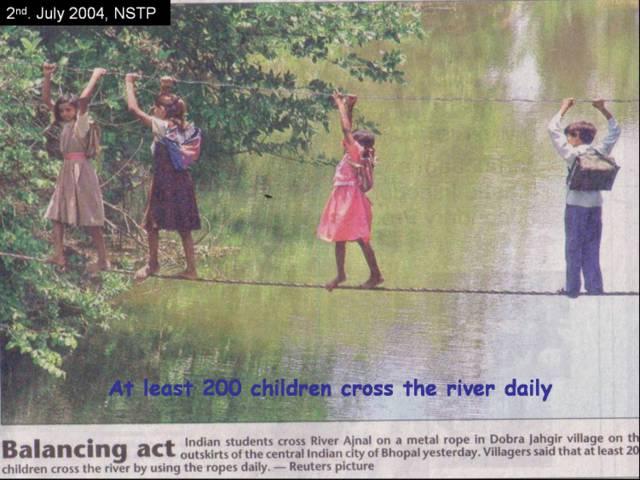
River Crossing Posted by Hello

Daily, about 200 children cross this river Ajnal on a metal rope in Dobra Jahgir village in India. Wonder when the Government will start building a bridge for these children? India and Pakistan spent billions in acquiring nuclear weapons which could be enough to build thousands of bridges and schools. The irony is that both country are basically one nation with two rulers, originally designed by the British using the philosophy of divide and rule, and later developed by the Americans to be sworn enemies so that both will need to spent all their money and pay billions to American manufacturers for their arms-race . If Germany can be united, then both of these country's rulers should wisely choose and set their priority right by having a peace treaty so that they need not continue to spent so much money to built their nuclear capabilities and armouries - sell them all to Saddam and Osama. Then, it would be absolutely right and fully justify Bush's action to attack Iraq and Afganistan. America claims they are the guardian of peace - let them handle it.

Wednesday, April 28, 2004

LITANY OF THE POOR MAN'S DREAM TO OWNED A MISERABLE LOW-COST HOME

LONGHOUSE & CITY SLUM

In Jeffooi's blog today, Jeff highlighted the issues of the squatters in Selangor.

(Quote)"Till today, I am still intrigued by Selangor MB Dr Mohd Khir Toyo's contention that Malaysia's most progressive state under his care is saddled with an overhang of 100,000 low-cost houses. He feels that the state government must help the housing developers to cut losses. If there is an over-supply, how come many of Selangor's subjects are still sentenced to squatters and city slums? ."(Unquote)

The Vision of zero squatters for Selangor is onerous and a tall order. Politicians and state leaders talks about it and thats all. If the Govt are sincere, and passionately sincere, much can be done to reduce the poverty level but it would mean that politicians must have less for themselves and their cronies. As long as the "billionaire syndrome" still exist amongst the politicians and the system of political economy still persist as it has been, the poor must resign themselves to be poor and continue to elect those who made them poor. Our main problem regarding this issue stems from a systemic failure and the lack of "Will" - are the political masters desirous of eradicating poverty and have they a strong-will power to want to resolve this problem? Which ministers house is not millions of dollars - stand up please and be counted!!!!!