Showing posts with label Biz. Show all posts

Sunday, December 18, 2011

A Trip to Kuching

I had wanted to make a trip to Kuching for sometime. Finally, after 2 years, I made the trip to Catland yesterday.

Thanks to my buddy Mr. Au and Arthur Yip, I got to Grand Margherita Hotel and was offered a beautiful room, a studio suite. The room is so cosy and big.


And it has a nice view from my room - you get to see the beautiful river and a swimming pool below.

I attended the Kuching Toastmasters Gala today.

Tonight's theme is: A celebration of Love

The members had a great time.


I met up with so many good friends and partners.

I will be going back to KL tomorrow and hope to be back soon.
It had been a fruitful trip with lots of excitement and plenty of business propositions.

Good night!

Saturday, December 11, 2010

Wealth: Lessons from Tadashi

Tadashi Yanai
Fast Retailing Chairman & CEO
By Eugene Mahalingam
StarBizWeek; Up Close & Personal; page SBW6
Saturday 11, December 2010

61 year-old billionaire Tadashi Yanai heads Japan's largest clothes retailer Fast Retailing, a company he took over from his father in 1984 under the name of Ogori Shoji.

According to Forbes Tadashi is Japan's richest man with a net worth of US$9.2 billion. The self-made billionaire said it was all due to hard work and perseverance that he is where he is today. But making money was never the biggest part of his plan in life. "I never pursued wealth. It came naturally. It is about the business, managing it, growing it and benefiting society."

"I believe that if you pursue wealth, you will always be chasing it," Tadashi said.

"A person pursuing success should not be afraid of taking risks and making mistakes. If you want to succeed, you have to experience failures. To me, the worst people in the world are those that neither succeed nor fail. These people don't do anything and accomplish nothing."

"The second worst types are those that continuously fail. They never learn from their mistakes and never succeed," he said.

"The world is constantly changing. To succeed in this environment, you need to make mistakes, fail, learn from them and move on."

"I have always been a risk-taker. But I only take risks as long as the company doesn't go bankrupt. You need to constantly evaluate the situation. If you don't take risks, you will never profit."

"Trust and credibility are the most important traits in growing a successful business."

"I consider myself a strict boss at the office. It is necessary if you need to do what is right. A lot of managers out there say a lot of things but they never do it. At the office it is 'his way or the highway.' If I say something whether in office or in public, it will be executed and I will do it. That's what sets me apart from others."

Favorite pastime? "I like reading books on business management by people that actually run their own business."

Work and play? "Work is my playground. I find it fun and enjoying."

***

Learn from the successful people. Success is a journey!

***

Thursday, January 29, 2009

Time dotcom: Declared Dysfunctional

Time Dotcom Bhd (TdC) CEO Afzal Abdul Rahim's Official Declaration:

TdC is DYSFUNCTIONAL; TdC is disconnected from the market.

TdC needs: a Total Overhaul, a Paradigm Shift, a new Business Plan, a set of Turnaround Initiatives and Divisional Initiative,s and some Quick Wins!

Afzal admitted that these are vital because TdC has too many leakages in operating expenses. Its spending for network is high, it is too dependent on vendors’ solution, it lacks direction, has no clarity and, most importantly, its product offerings are too complex.

“This company has structural issues and people work in silos. We have to be conscious that we are dysfunctional as an organisation and we have to do basic cleaning up as we can get simple things wrong.

“If we do not change everything in the peripheral, we cannot achieve the target and that is why a complete overhaul is needed,’’ chief executive officer Afzal Abdul Rahim told StarBiz in an interview.

He said the structural problems came about because “people were too busy organising functions around personalities and this resulted in them building silos and empires which led to no synchronisation.”

“There is clearly a lack of direction and clarity and everyone only thought of his own work. (TdC has been looking inwards) and that is why TdC is disconnected from the market. We did not know what the market wanted,’’ Afzal said.

Afzal came on board in October last year and that is what he discovered after more than three months at the helm.

He has a three-year mandate from Khazanah Nasional Bhd to turn TdC around.

TdC has been suffering from internal hemorrhage; it has been losing money for more than a decade.

Turnaround? How are they doing it?

From observations, they are:

(1) Removing existing executives using VSS and parking new executives into the old job role (85% of the executives were replaced - 23 out of 27);

(2) Cost Reduction Initiatives: (i)Cutting operating expenditures from RM100 mil to RM40 mil. & moving office from it's Jalan Tun Razak leased-premises to its own premise at Glenmarie in Shah Alam.;

(3) Flattening the organizational hierarchy to enhance visibility;

(4) De-coupling from the United Engineers (M) Bhd (UEM) group and Time Engineering Bhd.

Will it work? Theoretically yes; empirically ... behemoth task and onerous. Turnaround is not just simply: putting on the right man on the bus and taking out the wrong people off; it is not just about having a good business plan and flattening the steep hierarchy. It is about a strong leadership, a strategic business action plan which are goal-centric with fixed time frame, a high performance team supporting and driving change, and a dynamic cashflow system which are driving the revenue growth & collections with a team of researchers empowered to innovatively drive cost-reduction without sacrificing or trade-off with elements that are contributing positively to the organizational processes. Most of all, the change and impact which provides positive contributions towards organizational goals and objectives are sustainable and becomes the new culture within the organizational system.

What about Rewards? But you can't have or sustain a high performance team without a strategic reward system: the rewards must be result-based, rewarding the "Lembu"and not just the "Sapi", and it motivates - the people on the job and continually drives their performances from good to great.

Strong leadership is not just about a good-talking leader or a friendly person; he leads by example and he has the vision and foresight of the businesses and he has the ability to identify good performers; most of all, he and his executives have the right attitude and are of strong character. However, he can do no better if his team are incompetent or inexperience : qualifications aren't just enough; these executives must possess on-the-job experiences, experiences in complexity and chaos management, experiences of similar failures from without and within, and excellent skills in Project Management, Financial Management, strategic Business Management and Risk Managemen; and most of all, they have the "Right Attitude" and with business-centric mentality.

Critical Failure Factors: mediocrity and ketuanan mentality, class & color differentiations, lack of focus or unsustainable focus, a new crony system replacing the old, talks well and talks often about performance instead of driving & ensuring performance are acted upon and measured on, good at meetings as well as spending too much time in meetings talking about performance and not spending time with the people on the job to manage the products and services to the customers/clients on time, with the right quality and at a competitive price, as well as managing the effective cost of the products and services.

I can only wish Afzal: "Best of Luck" and "May God Bless You and Your Team".

Sunday, September 21, 2008

Innovation & Creativity

In today's world of global competition, innovation and creativity are the basis for continuously sustaining business and survival of the fittest.

According to Tom Peters, there are two ways for organizations to create and sustain superior performance over the long haul. First, is to take exceptional care of your customers via superior service and superior quality. Second, is constant innovation.


Latest innovation for camera:


Limited edition. First come, first serve.

Made in Malaysia?

***

Saturday, July 19, 2008

Gates' Rules

Bill Gates recently gave a speech at a High School about 10 things they did not and will not learn in school. He talks about how feel-good, politically correct teachings created a generation of kids with no concept of reality and how this concept set them up for failure in the real world.

Rule 1 :
Life is not fair - get used to it!

Rule 2 :
The world won't care about your self-esteem. The world will expect you to accomplish something BEFORE you feel good about yourself.

Rule 3:
You will NOT make $60,000 a year right out of high school. You won't be a vice-president with a car phone until you earn both.

Rule 4:
If you think your teacher is tough, wait till you get a boss.

Rule 5:
Flipping burgers is not beneath your dignity. Your grandparents had a different word for burger flipping: they called it opportunity.

Rule 6:
If you mess up, it's not your parents' fault, so don't whine about your mistakes, learn from them.

Rule 7:
Before you were born, your parents weren't as boring as they are now. They got that way from paying your bills, cleaning your clothes and listening to you talk about how cool you thought you were. So before you save the rain forest from the parasites of your parent's generation, try delousing the closet in your own room.

Rule 8:
Your school may have done away with winners and losers, but life HAS NOT. In some schools, they have abolished failing grades and they'll give you as MANY TIMES as you want to get the right answer. This doesn't bear the slightest resemblance to ANYTHING in real life.

Rule 9:
Life is not divided into semesters. You don't get summers off and very few employers are interested in helping you FIND YOURSELF. Do that on your own time.

Rule 10:
Television is NOT real life. In real life people actually have to leave the coffee shop and go to jobs.

Bonus Rule 11:
Be nice to nerds. Chances are you'll end up working for one.

My Rule No.1:
Get on with life; there's just too much unaccomplished and to be accomplish.

*** ***

Wednesday, December 12, 2007

Tony Fernandes: Zero Political Connection???

Tony Fernandes, AirAsia CEO said: "We were just 3 guys from the music industry with not a lot of money, no experience, no political connections - zero. No one can say that no one gets equal opportunities. I did. I am living proof that we can.

Tony, I admired your success. You are living proof of what a person , with the passion and dedication can achieve. But, please do not lie and say you have started acquiring AirAsia from nothing, without political connection. The government would not give the Air Line Biz to you if you are just Tony Fernandes. You have Pahamin, and I don't have to elaborate further. Mahathir, the PM, and Daim, the Finance Minister, both gave him the opportunity. No Tom, Dick or Harry, with just passion and ambition will get the licence to operate an airline, what more, the one that belongs to DRB-Hicom.

Three of you did not have lots of money; I agreed, but you can't operate that Airline without multi-millions, and that's money beyond the means of the ordinary folks.

Oh, BTW, no one can say no one gets equal opportunities... to some extent, depends of what kind of opportunities and the "right connection". Ask an ordinary folk to get a PKK Class A licence and a DBT/Turnkey project from EPU; try lah, and see if you can get, with ZERO political connection, and No Money... I didn't live in Timbaktu; I'm Malaysian and have been in the industry long enough to understand the truth and reality; and all my bosses understand reality... that's why they get projects.

Tuesday, November 20, 2007

Give Licence; Take back Licence!

Energy, Water & Communication Minister Lim Keng Yaik said "The government will withdraw some licences given to firms to offer high-speed Internet services using WiMAX technology as the market is too crowded".

The licences, for 2.5 gigahertz (GHz) and 3.5 GHz spectrums, will be taken back over a five-year period.

"There are too many WiMAX players. When you have too many players, they will kill each other," Keng Yaik said.

"Majority of them, after two to three years of obtaining the assignment don't have more than 10 customers and some don't even have any customers," Dr Lim.

Too many? When you first approved all of them didn't you take into consideration that this would be the scenario? Some of them have no customer at all? Ali Baba-ism didn't work?

The government gave licences to four companies to operate the 2.3GHz airwave. They are Bizsurf (M) Sdn Bhd, MIB Comm Sdn Bhd, Asiaspace Dotcom Sdn Bhd and REDtone-CNX Broadband Sdn Bhd.

Eight companies have licences to use WiMAX-related equipment while four firms won the permit to use the 2.5GHz and 3.5GHz airwaves.

It is disappointing to note that some licence holder do not have a single customer. Even Time.com who was given the 3G licence had not operated and had now sold the 3G spectrum to DiGi, who was not granted the licence. So you can see that those who merit the licence are not given and DiGi had to pay some $600 million to acquire the 3G spectrum from Time.com. That's how money is made without lifting a hand to invest. All you need is political patronage and thereafter, sell the rights to someone who deserved by merit but was discriminated.

On another concern is the fact that if licence can be issued and taken back at will by the authority, how could investors be confident on investing here?

Let's take another issue... Minister in the Prime Minister's Department Nazri Aziz said "There will be no bumiputra recruitment quota for multinational corporations (MNCs)." Nazri said "this was because the country would lose its competitiveness if the Government should impose such a policy."

Now if we are to consider the statement from Keng Yaik, shouldn't investors and MNCs be fearful of the ability of the authority who may at a later date decides otherwise?

This is a similar dilemma Singaporeans are facing when considering to invest in Iskandar Development Region (SJER).

At the present moment, the State Government wanted investments in SJER and are luring the Singaporeans.

The Mentri Besar is offering olive branches to potential investors and were even prepared to forego the 30% Bumi equity. But Singaporean government had a bad experience when their investments by Temasek Holding in Pantai Hospital were questioned by none other than Khairy Jamaluddin at the UMNO General Assembly two years ago and ultimately caused Khazanah to acquire the stakes from Temasek who had to exit to mitigate the political risks. That's why till today, no Singaporean firms had yet to take up the opportunities in SJER even though there are so much exceptions promised by the State government.

The Arabs too had learned a lesson or two such as that of Port Klang Free Zone (PKFZ). Jebel Ali Free Zone (Jafza), a Dubai-based Free Zone operator had to withdraw their management concession for PKFZ because of bureaucracy, interference by politicians and others with vested interests, deliberate incorrect minuting of meetings and even attempts at tax evasion by the Malaysian negotiators. The separation was acrimonious.

Noel Gulliver, Jafza's man, who was PKFZ general manager was forced out from his office and taken to the Immigration Department. Graham Lovett, Gulf Managing Partner of Clifford Chance in an e-mail to Chuck Heath, Jafza International senior vice-president (international operations) expressed his distrust of the Malaysian negotiators. Graham Lovett expressed his grave concern that "... Jafza did not and does not want to be a party to any tax problems with the Malaysian government ... Lovett expressed his concerns that "...they are not acting in good faith." In a letter to Transport Minister Datuk Seri Chan Kong Choy, Heath said red tape had hampered the progress of the free trade zone as among others, Jafza had to deal with 27 government departments involved in the client approval process. Heath wrote: "There has been a total lack of government planning ... He added that there is a lack of transparency... "Unfortunately," Heath added, "without radical surgery in cutting out the above obstacles, we feel this project is doomed to failure.“ Jafza officials had also met the PM to express the anomalies and shortcomings in PKFZ.

The whole mess in PKFZ is testimony as to why foreign investors shy away from Malaysia. We add the case of Pantai Hospital and WiMAX, and many others, the list will be voluminous.

Saturday, November 03, 2007

Business Management Lesson 1

X'tina blog about MBA(Mentally Below Average)- Management Lesson. I am also going to blog about management lesson.

So, this is Lesson No.1: Total Business Failures

At a Business Management class, a lecturer asked 3 students to give an example of Total Business Failure (TBF).

John: "HP-Compaq merger".

Lecturer: "That's not TBF. Its only a business initiative failure."

Mary: "Enron".

Lecturer: "That failure is caused by a breach of directors duties and the element of fraud, not a Total Business Failure."

Susie: "Pregnant prostitute."

The class roared in approval. Lecturer pengsan!

Friday, September 28, 2007

China Quality - Mattel Toy Episode

I was attending a presentation on Quality System and ISO9000.

The issue of Mattel toys and made-in-China quality was forwarded as an example whereby, 2mil made-in-China Mattel toys was recalled. The illustration was that this incident portrays the poor quality system of China's manufacturing and products.

I objected. Mattel Inc. is an American toy company and those dolls and toy cars were manufactured in accordance to the design and quality standards specified and if they did not comply, then the quality issues should have to be investigated and the root cause established.

As it finally came to light, Mattel Inc. executive vice-president, Thomas A Debrowski issued a public apology to the Chinese. Debrowski said:

"Mattel takes full responsibility for these recalls and apologises personally to you, the Chinese people and all of our customers who received the toys. ... the vast majority of those products that we recalled were the result of flaws in Mattel design, not through a manufacturing flaw by Chinese manufacturers."

The problem as it turned out was mostly due to the Mattel's design flaw.

In the age of globalisation and with the internet as the instant provider of information, perception alone do not dictate sales. Information are delivered instantaneously and the pace is getting faster and faster. Competition is getting tougher and bloodier. Consumers now have the ability to evaluate and compare the quality aspects from informations derived from the cyber-space. Only world-class companies can thrive and survive this tremulous environment. Red ocean or blue ocean, it doesn't really matter. What matters is competitive advantage and customers' delight. Quality is not just compliance; it now has to be more than that.

Tuesday, July 24, 2007

Microsoft Conquer China or was Conquered

How Microsoft Conquered China

Or is it the other way around?

by David Kirkpatrick
Fortune 500
July 23, 2007
Vol 156, No.2

Abstract:

No other Fortune 500 CEO gets quite the same treatment in China. While most would count themselves lucky to talk with one China's top leaders, Bill Gates gets to meet with 4-members of the Politburo.

When Chinese Premier Hu Jintao visited Microsoft campus in Redmond, Washington, and was feted at a dinner at Gates home, Hu told his host: "You are a friend to the Chinese people and I am a friend of Microsoft. Every morning I go to my office and use your software."

Microsoft bumbled for years after entering China in 1992. It finally figured out that almost none of the basic precepts that led to its success in the US and Europe made sense in China.

It took Microsoft 15 years and billions of dollars of lost revenue to learn how to do business in China. "We were a naive American company," concedes Gates in an interview.

15 years ago, Microsoft sent a couple of sales managers into China. Their mission? To sell software. "It was a classic model - hang out a shingle and say, 'Microsoft: Open for business," Craig Mundie, the top Microsoft executive who now guides its China strategy said.

But the model failed, not because of brand acceptance but just that no one is paying - counterfeiting.

"In China we didn't have problem with market share. The issue is how do we translate that into revenue," said Ya-Qin Zhang.

Microsoft fought bitterly to protect its intellectual property. It sued but lost regularly in Court. Microsoft's strategy failed miserably and in a 5 years period, they had changed 5 country manager.

In 1999, Gates sent Mundie to figure out why Microsoft was so reviled. On the trip he had an epiphany: "Our business is just broken in China."

Mundie concluded that the company was assigning executives too junior and that selling per se was overemphasized. "Our business practices and our engagement did not reflect the importance of having a collaborative approach with the government."

Microsoft executives were concerned with China's weak IP-enforcement laws. However, Gates argued that while it was terrible that people in China pirated so much softwares, if they were going to pirate anybody's software Gates certainly preferred it to be Microsoft. Bill Gates openly concedes that tolerating piracy turned out to be Microsoft's best long-term strategy. That's why Windows is used on an estimated 90% of China's 120 million PCs.

"It is easier for our software to compete with Linux when there's piracy than when there's not," Gates says.

Microsoft's China strategy is clearly paying off. More than 24 million PCs will be sold this year, adding to the 120 million already in place.

"We have already found a win-win way of doing things together that will generate a substantial part of Microsoft's growth in the next decade," declared Gates.

(go get a copy of the Fortune 500 Vol. 156. It's worth it, just for this piece.)

Saturday, April 21, 2007

Perangsang sings a new song with Samy


Kumpulan Perangsang Selangor Bhd (KPSB) may have failed in the Matrade Building project.

Samy Vellu may had said that he will go after the culprit and it's directors.

But all is well in KPSB. They are now looking at acquiring Puncak Niaga's 70% equity interest in Syarikat Bekalan Air Selangor (Syabas). The balance 30% of Syabas is held by Kumpulan Darul Ehsan Bhd (KDEB), the Selangor government's investment arm.

Who will stand to gain with this acquisition?

Will Selangor govt pay the acquisition by cash or to issue shares which will result in Tan Sri Rozali becoming the ultimate majority shareholder of KPSB?

Reverse talkover or forward acquisition? Guess the game of money.

Tuesday, April 10, 2007

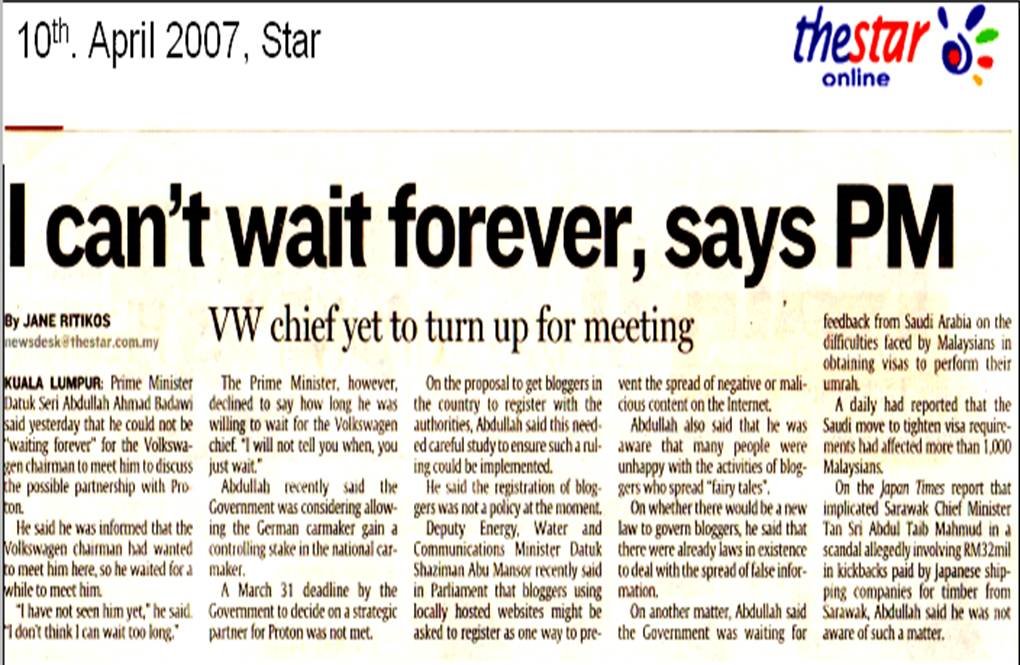
Long Wait for Wagen

Prime minister Pak Lah was pretty upset.

He had to wait for hours in order to meet Volkswagen chairman who had wanted to meet him. The wagen chaorman did not turn up.

The PM was extremely upset and said: "I don't think I can wait too long."

The PM was asked by reporters how long would he wait for Wagen to respond. PM declined to say how long: "I will not tell you when, you just wait."

That means he is willing to wait.