Showing posts with label KPI. Show all posts

Saturday, June 02, 2007

GLCs KPI: Dreams or Nightmares?

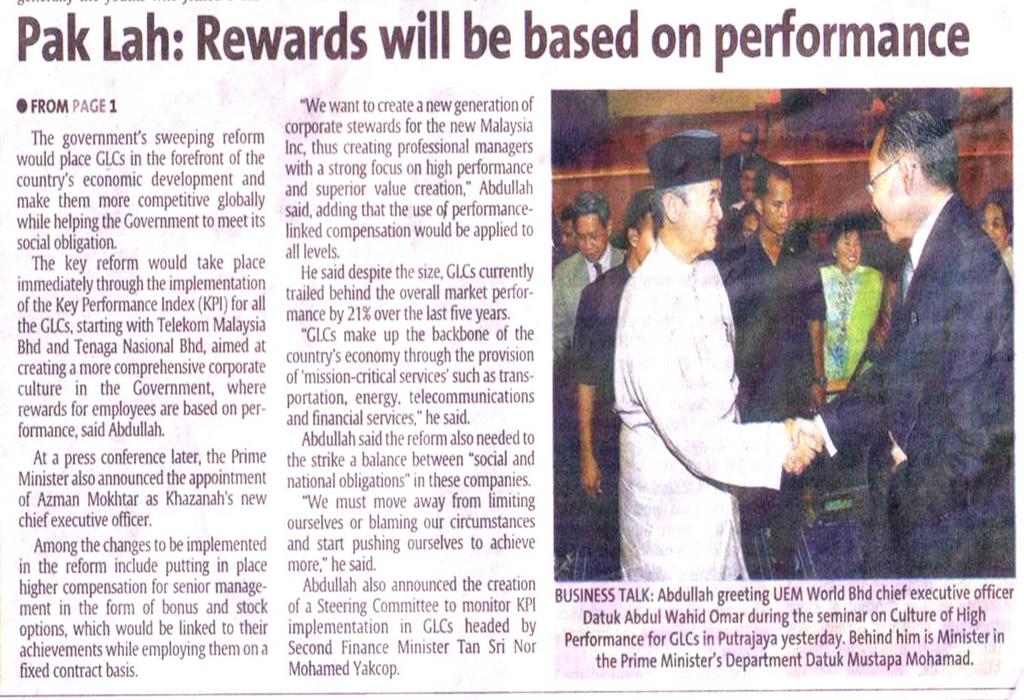
In 2006, Prime Minister Pak Lah wants all GLCs to have their KPI.

Khazanah under the new CEO Azman Mokhtar announced a set of reasonably impressive KPI which must have extremely motivated the Prime Minister and his coterie of CEOs.

In January 2006, the new CEO of Proton Syed Zainal Abidin proclaimed that Proton would surely be turned around in ONE YEAR!. He was so confident and sure of his ability to turnaround the cancer-struck corporation.


By March 2006, Proton par laid their strategic mission and goals and issue to the public a set of the Key Performance Indices (KPI) targeted for the year.

Market share is projected to increase to 45.8% from 41.4% of 2006

Export sales will be increased to 8.6% from from 5.2% in 2006

Revenue will grow by 12.4% for FY 2007

EBIT growth will be 2.5% against 0.5% in 2006

This projections are not extremely delightful but are satisfying if it is achieved.


Finally, the Fiscal Year Performance results were out.

Revenue drop by 29%, Car sales drop 40%, EBIT goes negative, export sales was also negative growth.


Today, Khazanah announced a new set of KPI for Proton FY2008.

It's ok if it is not achievable; afterall its mere figures and was also meant to be a target to motivate ... motivate the Prime Minister only.

The message is clear, just try lah!

Kalah tak apa, gaya mesti mau!


Anyway, congratulations to Azman Mokhtar for receiving his new title Tan Sri.

Hi PM, are you ok?


\

Be patient! They are trying very hard.

Friday, February 16, 2007

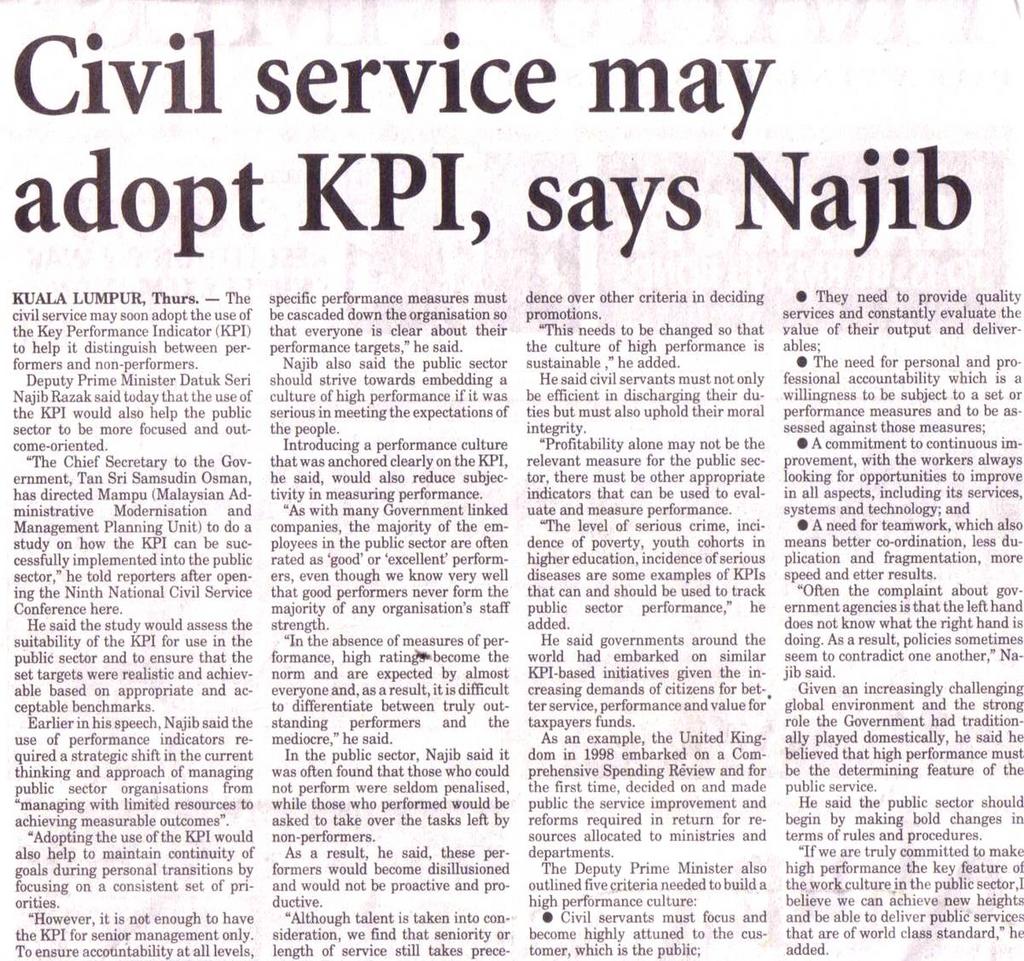
Civil servants pay rise based on Productivity?

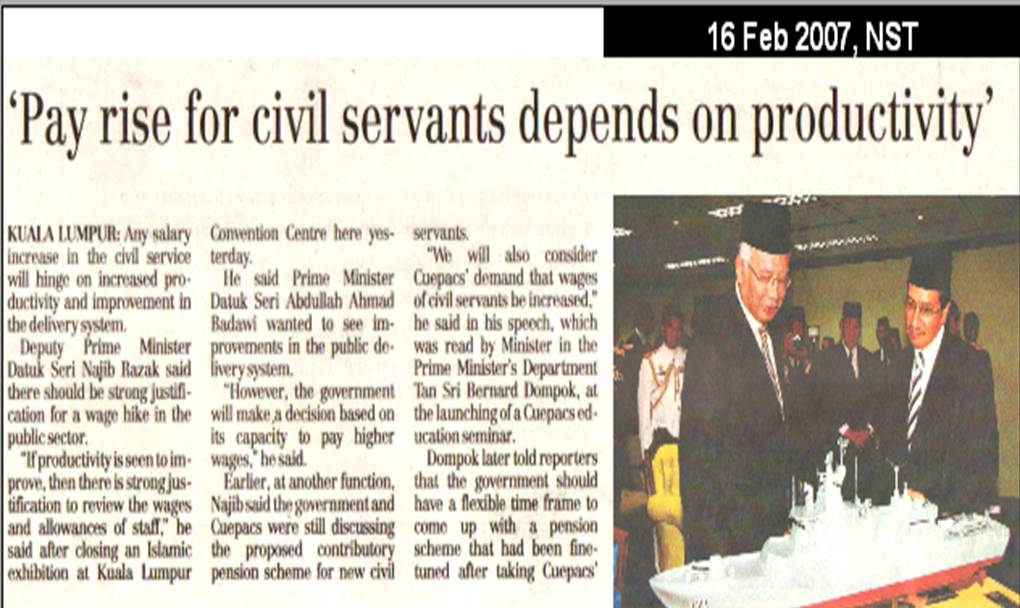
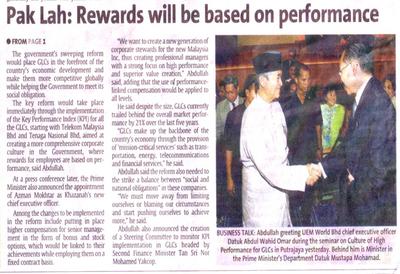
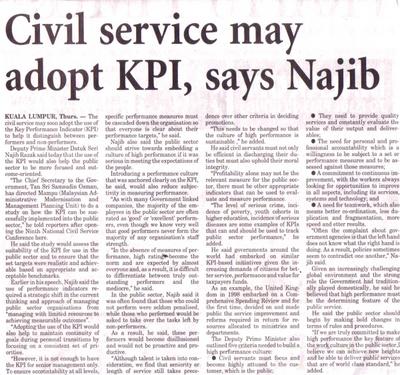
DPM Najib said any salary increase in the civil service will hinge on increased productivity and improvement in the delivery system.

This is a fantastic idea but how do the govt implement such a system? Using KPI and Balance Scorecard? But how was the KPI developed?

I remembered the EPF used the balance scordecard and KPI system and at the end of the year, almost all the staff achieved more than 0.8KPI (1.0 is the maximum). The subject issue becomes, how do EPF grant promotion to every staff who had achieved more than 0.8 as stipulated? The answer was: the management decided to use the 80:20 rule; throw out 80% of those who achieved and finally, only 20% was given promotion and adjustments. But that defeat the very purpose of the KPI system which has an integral sub-system called Reward System.

The KPI was needed to guage and measure performance and it states that those who achieve the required score will get rewarded accordingly. Ultimately, it was still discretionary and arbitrary decisions of top management wins the day.

The fact remains that the KPI was in itself arbitrary and the measurement terms were so subjective and discretionary. Millions was paid to the consultants to develop these KPI only to find that it will not work in our cultural environment. In the civil services and quasi-govt organizations, the superior who append those KPIs would usually give high scores to their subordinates. This can be due to the fact that the superiors themselves are also lazy, or the fact that almost all their staffs are lazy and if they scored them low, their department would collapse as a whole. KPI? ya, it can work provided that the working culture is in itself based on merits.

Tuesday, February 13, 2007

Would the Govt really listen or merely hearing?

The Government is inviting Malaysians from all walks of life to give suggestions on how to improve the public service delivery system.

You can e-mail your suggestions to improve@mampu.gov.my from now until Monday.

The Malaysian Administrative Modernisation and Management Planning Unit (Mampu), under the Prime Minister’s Department, will compile your feedback and submit it to the department.

Mampu said it was drawing up a plan to produce a “modern, responsive and effective” public service.

“Mampu invites all Malaysians to submit proposals or suggest improvements which can be implemented in the short, medium and long term.

“The civil service should redouble efforts to elevate the nation’s position to the Top 10 in any global competency report, as suggested by Prime Minister Datuk Seri Abdullah Ahmad Badawi,”Mampu said.

This news is heartening and received as good news but not new. The govt wanted to improve the efficiency and quality of service of the police force and a commission was setup to study and made recommendations. Till today, that plan was meant for the shelve - archived - for good.


The government had on various occasions instructed the treasury to ensure that contractors be paid on time, and this was repeated so many times over the 3 years since Pak Lah became PM. The situation is analogous of the imminent past.

The 880 projects to be awarded as promised...most of it is still in the drawing table, for various reasons - could not be implemented, primarily because the project funds had yet to be made available. Cakap Tak Boleh Serupa Bikin.

9th Malaysia Plan and RM200bil projects - plan done, published and spinned, most of it is under negotiation and the primary issue is still political charitable transactions unfulfilled.

When Pak Lah came into power, he had assured that projects will be awarded on an open tender basis. So far, almost all, if not all the projects are negotiated-DBT/Turnkeyed, except for some Class D, E and Class F contracts. I even had seen a letter of intent for a project that is only worth RM5mil and is also negotiated contract. Where is the open-transparent tender system. Ask JKR if they are honest enough to tell the truth: how many projects had they awarded by open tender system as compared to negotiated ones.

BTW I would like to make a suggestion on the delivery system affecting the construction industry. CIDB is collecting hundreds of millions each year from the contractors; what had these contributing contractors gained apart from the few cronies who got some jobs in India, Sri Lanka and Vietnam?

Thousands of contractors are small and medium size who are not eyeing overseas project; what do they get from CIDB? Isn't CIDB the construction industry development board that is suppose to promote the level of competency and knowledge in construction management? Why is it that they are only drawing up seminars and issuing greencards?

That's all they can do? I mean: promotion of the construction industry as a whole is all about issuing greencard, organizing seminars and certifying project managers? A great shame!

The construction industry needed commercial databases such as the prices of materials at the various district and states nationwide, the cost of labour for each of the various trade for each state and district throughout the country, the productivity indexes, for example: a skilled carpenter will do 10ms/manday, skilled bricklayer productivity is about 9ms/manday, all of which would assist the industry to formulate a tracking system to monitor and control the project schedule. Other informations needed by the industry players are such as Cost databases, Quality Assurance Plan and Project Quality Plan (templates and best practices) Risk Registers templates: Risk identification, quantification and risk response planning and industry best practices on construction risk management ----- contractors don't need seminars from CIDB; there are plenty being organized by private institutions and most organizations have in-house training and workshops for their technical personnels. Contractors must have competent project managers but for CIDB to certify them, they, the certifiers from CIDB, must themselves be competent and accredited project managers, and had been certified and accredited by a recognized international accredited institution such as PMI, USA or APM, UK.


I won't write to Mampu; if anyone from Mampu read this, you may pick it up as a sign of your readiness to accept criticism and suggestions for improvement.


Wednesday, September 21, 2005

Balanced Scorecard for the Unbalanced


Harvard Business Review published the article “The Balanced Scorecard – Measures That Drive Performance” which was jointly written by Dr. David Norton (the then CEO of Nolan-Norton and now President of Balanced Scorecard Collaborative-BSCol) and Professor Dr. Robert Kaplan of the Harvard Business School.

The article summarized the findings from an in-depth study of 12 manufacturing and service companies that was carried out in 1990.

The research program set out to design a new approach to performance measurement that dealt with a growing managerial problem – that accounting, or financial, measures were increasingly being found wanting in assessing and managing organizational performance.

Norton and Kaplan premised that what business leaders required was a new mechanism with which it can take a holistic view of organizational performance, thus, providing more than the lagging financial metrics on which most organizations had based their decisions.

Consequently, Norton and Kaplan introduced a new performance measurement framework, which they anmed it:

The Balanced Scorecard


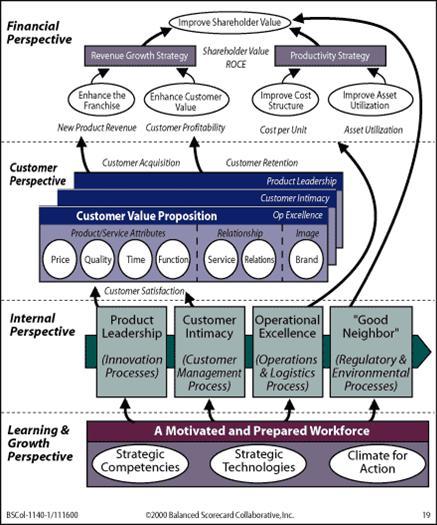
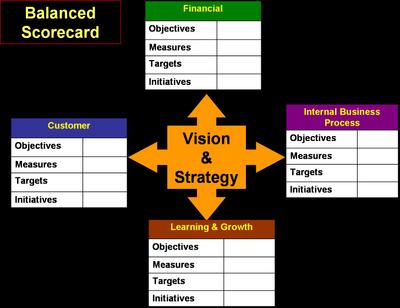
The balanced Scorecard is a management system that enables organizations to clarify their vision and strategy and translate them into action. It provides feedback around both the internal business processes and external outcomes in order to continuously improve strategic performance and results. When fully deployed, the balanced scorecard transforms strategic planning from an academic exercise into the nerve center of an enterprise.

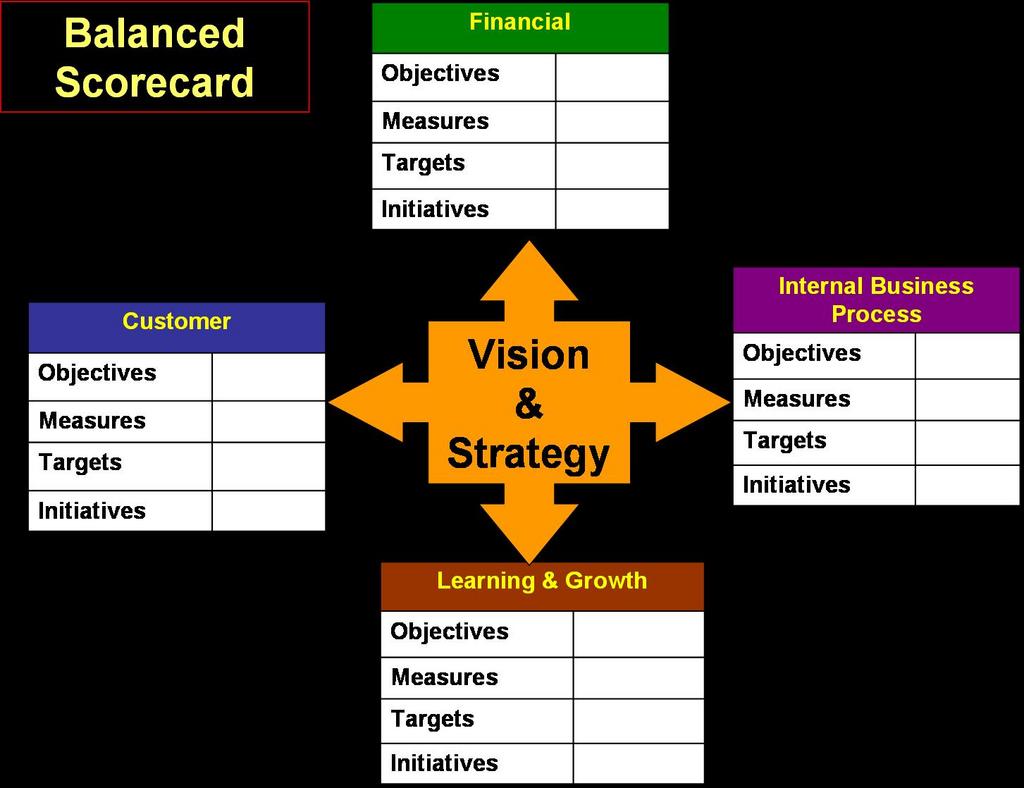
The Balanced Scorecard is basically a strategy management and implementation system that comprise a Strategy Map and an accompanying Balanced Scorecard of strategic measures, targets, and initiatives.

The Strategy Map serves as a strategy implementation roadmap in that it describes the high-level strategic objectives that the organization must deliver if it is to successfully execute its strategy.

Central to the premise of the Balanced Scorecard philosophy is that successful strategy implementation is the result of causal relationships within and between typically three non-financial perspectives and one financial perspective. The argument has it that succeeding against objectives from the learning and growth perspective (which forms the foundation of the Strategy Map) has a causal effect on success from the internal process perspective, which in turn creates success from the customer perspective and finally from the financial, or shareholder perspective.
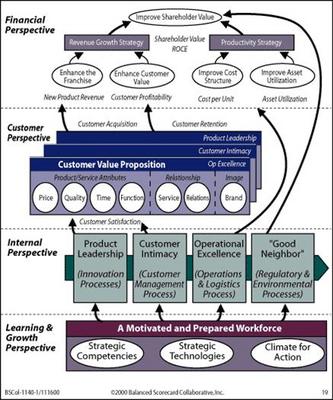


Crucially, the Strategy Map and accompanying scorecard is a hypothesis. It is management’s best guess as to what is required to implement the strategy. The Balanced Scorecard basically provides a framework to translate a strategy into operational terms.

To understand and implement the Balanced Scorecard Management System, we first need to understand the five principles of the Strategy-Focused Organization (SFO). These principles as adopted and adapted by Norton and Kaplan, and are required for the successful strategy implementation.

The first principle is to translate the strategy to operational terms. It incorporates the framework for articulating strategic objectives, measures, targets, and initiatives. Strategy Map and Balanced Scorecard may be created at the enterprise-level and then devolved to the functional level.

The second principle is to secure synergistic benefits which require the explication of common themes and objectives than are developed at the organizational level. The components are corporate roles, business unit synergies, and shared service synergies.

The third principle is to make strategy everyone’s everyday job. This is where strategy is moved out of the boardroom and into backroom. Strategic awareness requires concerted, ongoing, educational, and communication efforts. The components are strategic awareness, personal scorecards, and balanced reward.

The fourth principle is to make strategy a continual process. The Balanced Scorecard is placed at the heart of the management system and it links budget to strategies which also calls for an inculcated strategic learning process. The components are budget and strategy linking, analytical and information systems, and strategic learning process which captures and act on strategic feedbacks.

The fifth and final principle is to mobilize change through executive leadership. In order to sustain the scorecard success, top management must introduce and champion the scorecard. Senior management must be galvanized behind the scorecard. The components are mobilization, governance process and strategic management systems.

The balanced scorecard methodology builds on some key concepts of previous management ideas such as Total Quality Management (TQM), including customer-defined quality, continuous improvement, employee empowerment, and primarily, measurement-based management and feedback.

You can't improve what you can't measure. So metrics must be developed based on the priorities of the strategic plan, which provides the key business drivers and criteria for metrics managers most desire to watch. Processes are then designed to collect information relevant to these metrics and reduce it to numerical form for storage, display, and analysis. Decision makers examine the outcomes of various measured processes and strategies and track the results to guide the company and provide feedback.

The goal of making measurements is to permit managers to see their company more clearly, from many perspectives, and hence to make wiser long-term decisions.

Modern businesses depend upon measurement and analysis of performance. Measurements must derive from the company's strategy and provide critical data and information about key processes, outputs and results. Data and information needed for performance measurement and improvement are of many types, including: customer, product and service performance, operations, market, competitive comparisons, supplier, employee-related, and cost and financial. Analysis entails using data to determine trends, projections, and cause and effect -- that might not be evident without analysis. Data and analysis support a variety of company purposes, such as planning, reviewing company performance, improving operations, and comparing company performance with competitors' or with 'best practices' benchmarks

A major consideration in performance improvement involves the creation and use of performance measures or indicators. Performance measures or indicators are measurable characteristics of products, services, processes, and operations the company uses to track and improve performance. The measures or indicators should be selected to best represent the factors that lead to improved customer, operational, and financial performance. A comprehensive set of measures or indicators tied to customer and/or company performance requirements represents a clear basis for aligning all activities with the company's goals. Through the analysis of data from the tracking processes, the measures or indicators themselves may be evaluated and changed to better support such goals.


1. The Learning and Growth Perspective
This perspective includes employee training and corporate cultural attitudes related to both individual and corporate self-improvement. In a knowledge-worker organization, people -- the only repository of knowledge -- are the main resource. In the current climate of rapid technological change, it is becoming necessary for knowledge workers to be in a continuous learning mode. Government agencies often find themselves unable to hire new technical workers and at the same time is showing a decline in training of existing employees. This is a leading indicator of 'brain drain' that must be reversed. Metrics can be put into place to guide managers in focusing training funds where they can help the most. In any case, learning and growth constitute the essential foundation for success of any knowledge-worker organization.

Kaplan and Norton emphasize that 'learning' is more than 'training'; it also includes things like mentors and tutors within the organization, as well as that ease of communication among workers that allows them to readily get help on a problem when it is needed. It also includes technological tools; what the Baldrige criteria call "high performance work systems." One of these, the Intranet, will be examined in detail later in this document.

2. The Business Process Perspective
This perspective refers to internal business processes. Metrics based on this perspective allow the managers to know how well their business is running, and whether its products and services conform to customer requirements (the mission). These metrics have to be carefully designed by those who know these processes most intimately; with our unique missions these are not something that can be developed by outside consultants.

In addition to the strategic management process, two kinds of business processes may be identified: a) mission-oriented processes, and b) support processes. Mission-oriented processes are the special functions of government offices, and many unique problems are encountered in these processes. The support processes are more repetitive in nature, and hence easier to measure and benchmark using generic metrics.

3. The Customer Perspective
Recent management philosophy has shown an increasing realization of the importance of customer focus and customer satisfaction in any business. These are leading indicators: if customers are not satisfied, they will eventually find other suppliers that will meet their needs. Poor performance from this perspective is thus a leading indicator of future decline, even though the current financial picture may look good.

In developing metrics for satisfaction, customers should be analyzed in terms of kinds of customers and the kinds of processes for which we are providing a product or service to those customer groups.

4. The Financial Perspective
Kaplan and Norton do not disregard the traditional need for financial data. Timely and accurate funding data will always be a priority, and managers will do whatever necessary to provide it. In fact, often there is more than enough handling and processing of financial data. With the implementation of a corporate database, it is hoped that more of the processing can be centralized and automated. But the point is that the current emphasis on financials leads to the "unbalanced" situation with regard to other perspectives.

There is perhaps a need to include additional financial-related data, such as risk assessment and cost-benefit data, in this category.

It must be noted that no strategy can last forever. New strategic focus must be redefined to take the organization beyond doing its best and sustaining competitive advantage in the global marketplace.

Many companies who had implemented the scorecard system had derived substantial benefits. As an example, Saatchi & Saatchi who was on the verge of bankruptcy in the 1990s, brought in a new senior management team and implemented the SFO and Balanced Scorecard system. They managed to achieved their financial revitalization six months ahead of schedule and the company was sold to Publicis Groups SA of France for more than $2.5 billion, which is 4.5 times its net worth. Other examples are MTR Corporation, Tata Motors, Gold Coin, Cigna Property & Casualty, Mobil Oil, Hilton Hotels, Scandia Insurance, Bank Universal, Centrepoint Properties, Singapore prison Service, and AT & T Canada.

In Malaysia, to my knowledge, the big names who had implemented the scorecard system include EPF, Petronas, DRB-HICOM, AmBank Group, Northport, Sunway Group, Negara Properties, and Pos Malaysia. It will be interesting to see the success story of these companies in relation to its implementation and its corporate restructuring exercise.


However, management must realize that merely possessing a Balanced Scorecard will not in itself deliver benefits. The Scorecard is not something that organizations can plug and play. It is not a software that will automatically implement strategy, or fix a broken organization, nor rectify a dysfunctional system. A bad management team will not be converted to good with the scorecard. The fundamental of successful implementation is the quality of the leadership which is central to achievement. Those organizations that are looking for quick fixes will in fact imbue more problems and generate far greater chaos. Another reason for failure is the management’s inability to built capability to sustain the program.

A final point of advice to those implementing this initiative: “Nothing can kill the scorecard system quicker than a CEO waxing lyrical about the critical importance of non-financial measures and then demanding that heads roll when financial results are down. Similarly, if financial resources are not dedicated to scorecard implementation, the initiative will be short-term and would die a ‘natural death’. It must be noted that for this program to be successful, CEO and his senior executives must give unconditional and unequivocal backing; otherwise, don’t bother to spent money on such program.


It must be stressed that the scorecard’s survival is the consequence of its careful observation of the basic rule of continued existence of which it will evolve. Given the speed of change in the global competitive environment, organizations innovate with ‘first-mover’ advantage or developing products or capabilities that are ahead of competitors will be able to reap substantial financial benefits and at the same time, crushed their competitors.

References & Recommended Readings:

Robert S. Kaplan & David P. Norton; The Balanced Scorecard; Harvard Business School Press; 1996

Robert S. Kaplan & David P. Norton; Strategy Maps: Converting Intangible Assets into Tangible Outcomes; Harvard Business School Press; 2004

Paul R. Niven; Balanced Scorecard - Step-By-Step: Maximizing Performance and Maintaining Results; John Wiley & Sons Inc; 2002

Mike Bourne & Pippa Bourne; Balanced Scorecard in a Week; Hodder & Stoughton; 2000

James Creelman & Naresh Makhijani; Mastering Business in Asia: Succeeding with the Balanced Scorecard; John Wiley & Sons (Asia) Pte Ltd; 2005

Friday, July 30, 2004

PERFORMANCE REVIEW - PART2

QUALITY HOSPITAL MANAGEMENT & STANDARDS
- How is the Key Performance Index established?????


Hospital Shams Posted by Hello

Screenshots...: "Mailbag: Wards 23 & 24, KLGH
From: nurulchan
Subject: request that you stake out wards 23 and 24, GH, KL
Date: Thu, 29 Jul 2004 08:11:22 +0000 "

This is a letter from Nurul Chan to Jeff Ooi pertaining to the quality of services at the hospital Kuala Lumpur.

Nurul's Statement of Point:

"The question is... how much money has been allotted by the government of today towards expanding and upgrading of hospital facilities AS a tax-payer I would be very happy to know how my income tax money has been put to use. Please do not let the health minister know about my request to you to see for yourself the terrible condition in ward 24 in this so-called GH, KL. I feel disgusted at the standard of health- care given to patients in this ward."

"May be a few pictures snapped by you or your colleague will speak words louder then mine to give the health minister and all the sleepy heads in the Badawi Cabinet a big shake-up. patients in these wards will appreciate it if the cramped condition in these wards become a thing of the past."

According to Rafidah Aziz, Malaysia is in a position to offer health service and medical services to foreigners as we are expert in hospital management and hospital construction.

Can we ask Rafidah to answer the above problem in relation to her statement published in the NSTP on 15th. July 2004?

Monday, July 26, 2004

EPF & BALANCE SCORECARD SYSTEM


EPF-BSC1 Posted by Hello

DO YOU KNOW WHAT IS BALANCE SCORECARD?
DO YOU KNOW BEFORE INTRODUCING BSC, WHAT IS THE FUNDAMENTAL REQUIREMENTS THAT MUST BE IN PLACE?
WOULD YOU BE ABLE TO FLY AN AIRPLANE WHEN YOUR ONLY EXPERIENCE IS DRIVING PROTON WIRA ON THE ROAD?

WITH BSC, WOULD YOU BE GETTING A MODERN 3-SEATER BICYCLE?


EPF-BSC2 Posted by Hello

DO YOU LIKE THIS NEW BALANCE SCORE-BIKE???

Sunday, July 25, 2004

PERFORMANCE-BASED SYSTEM


Marina Posted by Hello

SYSTEM DEVELOPMENT OF PREVENTION-BASED PROGRAMMES

- "The Curse of Bureaucratic Mulfunction."

“When it comes to prevention programmes, Malaysia is NowHere.”
“I cannot think of any large-scale programmes.”
“Small-scale projects are not going to make a difference.”
“We are trying to get to grips with a problem we cannot see, but you do not want to get to the point where it (the AID's curse) can be seen.”

This is a great erudition by Datin Paduka Marina Mahathir as she was commenting on the AIDS' prevention development programme in Malaysia.

Her wisdom is not only applicable in the AIDS programme, but to all management processes within the govermental and organizational system which are sufferring from a variety of immune deficiencies syndrome - "The Curse of Bureaucratic Mulfunction."

With Pak-Lah's Vision of an "Efficient, Productive, Effective and Clean Government," the re-organization and restructuring process of the Government Link Companies and the various Ministries will not produce long-term sustainable effective-results if (in the same words of Marina) "we do not have a large-scale programme to take "GRIP" of the current deficiencies and viral infections that had penetrated deep inside the Governmental Body System.

As voiced by Marina, "do we want to get to the point where it (the AIDS curse) can be seen and "disaster" draws nearer?

Eradicating poverty cannot be achieved if hundreds of millions had to be spent in UMNO, MCA & MIC elections and the General Elections. Where do these monies come from? Certainly, someone had to pay for it and those who pay for it will need a "Return of Investment" from the Political Masters.

Efforts to eradicate and Mitigate corruption cannot be effective if politicians needs hundreds of millions to win votes and greasing the grassroot to get their support. The Government keeps churning out billions of dollars of projects to solicit political funds (and Masuk-Poket too). Almost Every politicians aspires to be billionaires (if they are not already one) and every project, particularly, those privatized, are tainted with money politics (actually, it should be "Money for politicians), "Top-UPs", "Political-Fund Contributions" and "Politician-Contributions'. Is these unknown to Pak-Lah - isn't it deep-rooted philosophy and disciplines inside the EPU & MOF?

Is the Government (or should I say, ONLY Pak-Lah)"desperate enough" in wanting a "Clean-Efficient-Effective & Productive" Government or do we prefer the Doctrinal System of:

"Cekap-Bersih-Amanah"
Cekap - Sapu cepat-cepat supaya ACA tak dapat nampak, cekap-nya.
Bersih - sapu sampai bersih - sikit punmau, dan banyak lagi baik, semua sapu.
Amanah - sudah banyak sapu, tentu-lah amanah.)

OR

"Cermelang-Gemilang-Terbilang."

Terbilang-bilang - kena bilang dulu sebelum bagi projek!
Ini memang Cermelang - style baru, cara lain, taktik yang inovasi!

- Excellence - what excellence?
Just look into our system - the Medical students fiascos, Nur Atiqah's dilemma, Perwaja's billions losses (and still bleeding profusely), Puncak-PUAS-SYABAS privatization conspiracy (& to suck consumers by the propose increase of water tariff by 45%), Bakun Damned (MMC-Syed Mokhtar dramatic-act), Double-track RM42billion LOI, Computer-Lab fiascos (Daim's Strategic design), 120 million contribution to PLUS for Jelapang-Toll Reconstruction (tax-payers money for construction & then pay toll again),etc, etc.

When will we learn? When do we wake-up? Till disaster-strikes down on us?

Tuesday, June 15, 2004

PTK UNDERMINES MORAL OF LECTURERS


Reality Bites-13th.June; Star Posted by Hello

TEST FOR COMPETENCY ASSESSMENT OF TEACHERS (PTK)

According to Rosli H. Mahat, the President of University Malaya Academic Staff Association, the recent PTK test failure was shocking. According to him, the test stress on administrative literacy rather than help academics improve their research skills and hardly focus on addressing the weaknesses of lecturers in enhancing the knowledge in their respective disciplines. (see: Star, 13th. June 2004)

Rosli question the relevance of the test. According to Rosli, it is probably because the passing grade for the PTK was so high that there is so much confusion as to the functions of these course that the management of MU had not publish the results of the lecturers.

Without disrepect to En. Rosli, it seem from his statement that lecturers do not like to read management books and administrative books. Somehow, many of these lecturers will be promoted someday to administrative positions and possibly, Governmental posts and Ministerial post such as was the case of the previous Education Minister who is a VC of University. How do we expect lecturers to perform administrative functions if they don't prepare themselves for these eventual posting?

The administrators of the PTK test should be questioned if according to Rosli, the PTK test is irrelevant.

The paradox of the PTK issue give rise to the question:

- "Lecturers teaches and guide students to be the future corporate, political leaders and managers. How could they if they themselves don't have the competency of administration?

- "We love promotion and we want to be given a chance to administer, to hold high position to become - ministers, CEOs of GLCs, VCs, etc, but as for exam and competency test, NO, NO, NO! We can become instant experts in management without test."

Pak-Lah, please give the lecturers the opportunity to be CEOs & COOs of the GLCs. Please tell Nor Yakcob to appoint them.

KEY (RUBBISH) PERFORMANCE INDEX


Putrajaya-12th.June;NSTP Posted by Hello

MALAYSIAN GARBAGE COLLECTION SYSTEM THE BEST

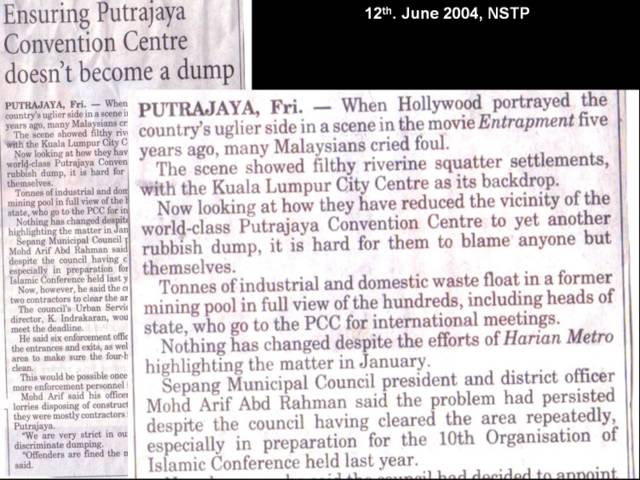
In the Hollywood movie 'Entrapment' produced in 1999, it portrays the Malaysian scenery as a dirty and filty place, full of squatters along the riverline. Then, Malaysian Government cried foul and accuses the American of inaccurate information.

Now, the newspaper publish a picture of Putrajaya lake within the vicinity of the Putrajaya Convention Center, full of rubbish, industrial and domestic toxic wastes, etc. Sepang District Officer and Municipal Council President Mohd Arif Abd Rahman gives an explanation to the problem: "The problem have persisted despite the council having cleared the area repeatedly especially for the OIC conference in 2003.

MY GOD! Our Malaysian standard is to clean a place for only a special event or function. We don't have a system for maintenance for public areas. Isn't such answers embarrassing? We have Government departments that presume that it is only necessary to maintain an area during functions or events, and thereafter ....

Thats the reason why the Velodrome in Perak is in such shamble state and UNrepairable.

The Government talks a lot about efficiency, effectiveness and Performance Measurement (KPI). Can Pak-Lah named the performance index for Municipal Council of Sepang? I would suggest that Pak-Lah and his cabinet visit Kuching and have a good site visit and discussion with the Municipal of Kuching and the Chief Minister of Sarawak. Does anyone visit the Lot10 and its surrounding in Bukit Bintang? How is the cleanliness of that place now? Mahathir did a cleaning exercise during the APEC summit many years back.


Putrajaya-dirty-11th.June NSTP Posted by Hello

Wednesday, April 28, 2004

SHOWING THE WORLD BY TESTING THE INCOMPETENCIES OF TEACHERS

PERNILIAN TAHAP KECEKAPAN (PTK) ASSESSMENT OF EFFICIENCY LEVEL TEST

The recent results by teachers who sat for the compulsory test of which only 1% had passed does indicate the quality of our school teachers. According to NUTP deputy president state president of Alor Star Mr Lim Cheng Uo, "people are joking that parents may want teachers to step down since they themselves cannpt pass an exam. They have asked how teachers will be able to teach their children and produce excellent students if they themselves fail their exams."

According to Education Minister Datuk Hishamuddin, "the poor performance of teachers in the PTK test is not reflective of their ability to teach.

This, I would agree but it does reflect that most teachers do not continuously seek refreshment of their knowledge, neither do they seek continuous education to enhance their knowledge and skills to better themselves. Personally, I do have many relatives who are school teachers and headmaster. I must be brunt to say that, "I don't seem to see their passion for readings and seeking more knowledge to enhance themselves and to face the growing challenges in the teaching industry. They are busy seeking additional income from conducting tuitions off-school hours and planning for holidays - quality family hours."

Hi Hishamuddin, you do not need to explain or give excuse for those failures. It would be much better to seek effective solutions to correct the weaknesses and prove that you had truly deserve to be the Education Minister, not another of the Minister who is there to seek personal mileages and wealth enhancement. The Sports Minstry you had just handed over to Azalina and the gamut of emotion that she expressed during her meeting with the officials of the sports associations is testimony on the problems she had inherited from her predecessors.